2026 Guide to the BEST Winter Hikes near Salt Lake City

The Wasatch Mountains may be known winter sports, but today, I will be showing you the best winter hikes near Salt Lake City, While winter hiking can be a bit of a wild card — from muddy and slushy conditions, deep powder, icy trails, avalanche risk, bone-chilling cold, to unusually warm temperatures — it is also incredibly rewarding!
If you love experiencing solitude on otherwise busy summer trails while also awing at the snow-blanketed wonderland, then winter hiking may be for you! However, preparation is the key between having either an awe-inspiring or miserable experience.
When I first hiked Lake Blanche in the winter, I was half frozen, miserable, and completely unprepared. I swore, “Never again!” A few years passed before I gave it another shot, and am I glad I did. Since then, I have been hooked! All it took were a few smart adjustments, and dare I say it, I even look forward to it now. Let’s get right to it!
Best Winter Hikes In Salt Lake City
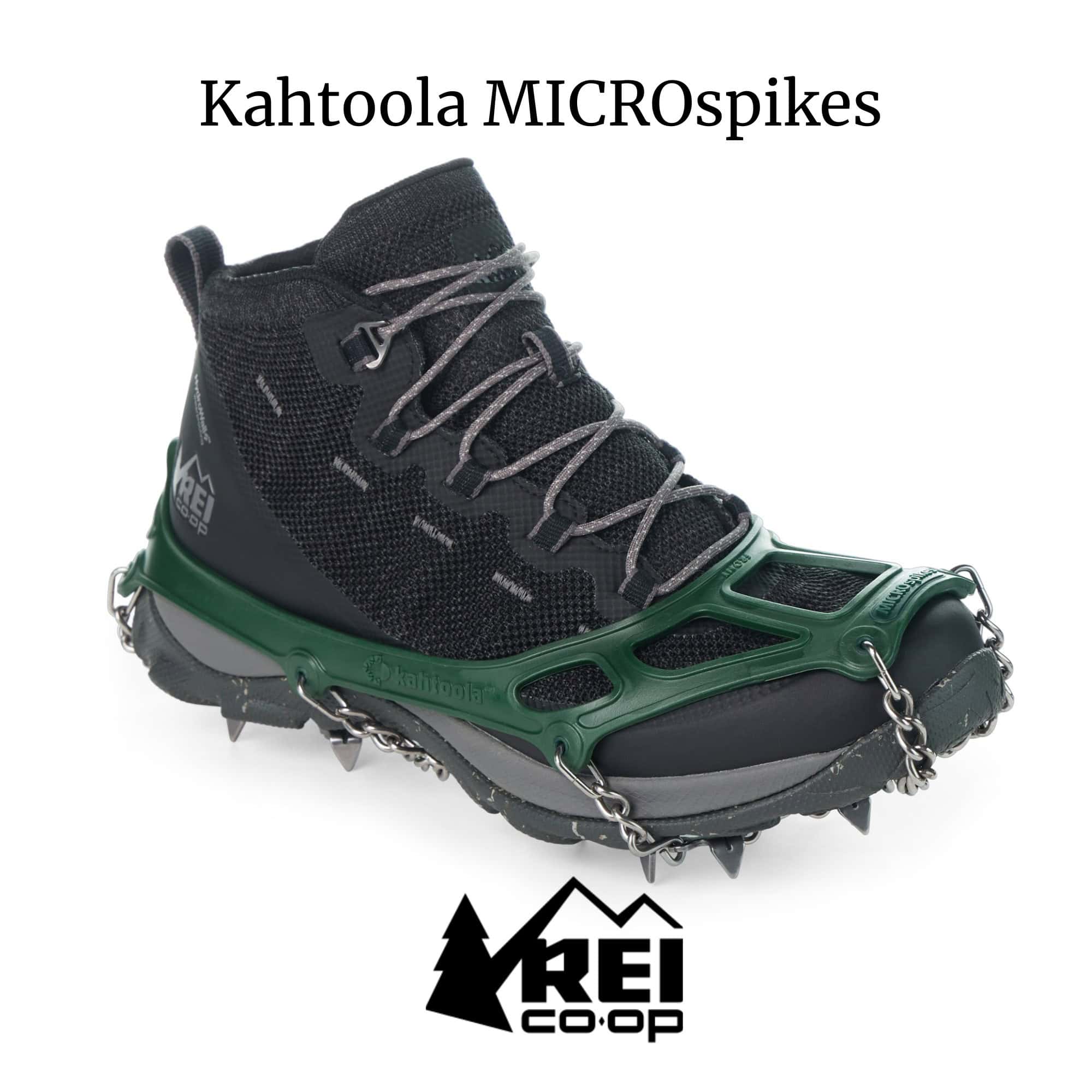
Before we dive in, I can’t stress the importance of being prepared for hiking in winter! First, buy a solid pair of Microspikes; they’re non-negotiable! Most of the hikes I am listing here get tracked out by other hikers, and as locals know, when it doesn’t snow for a few weeks, the trails turn VERY icy. Hiking without proper traction devices is very dangerous and can result in injury.
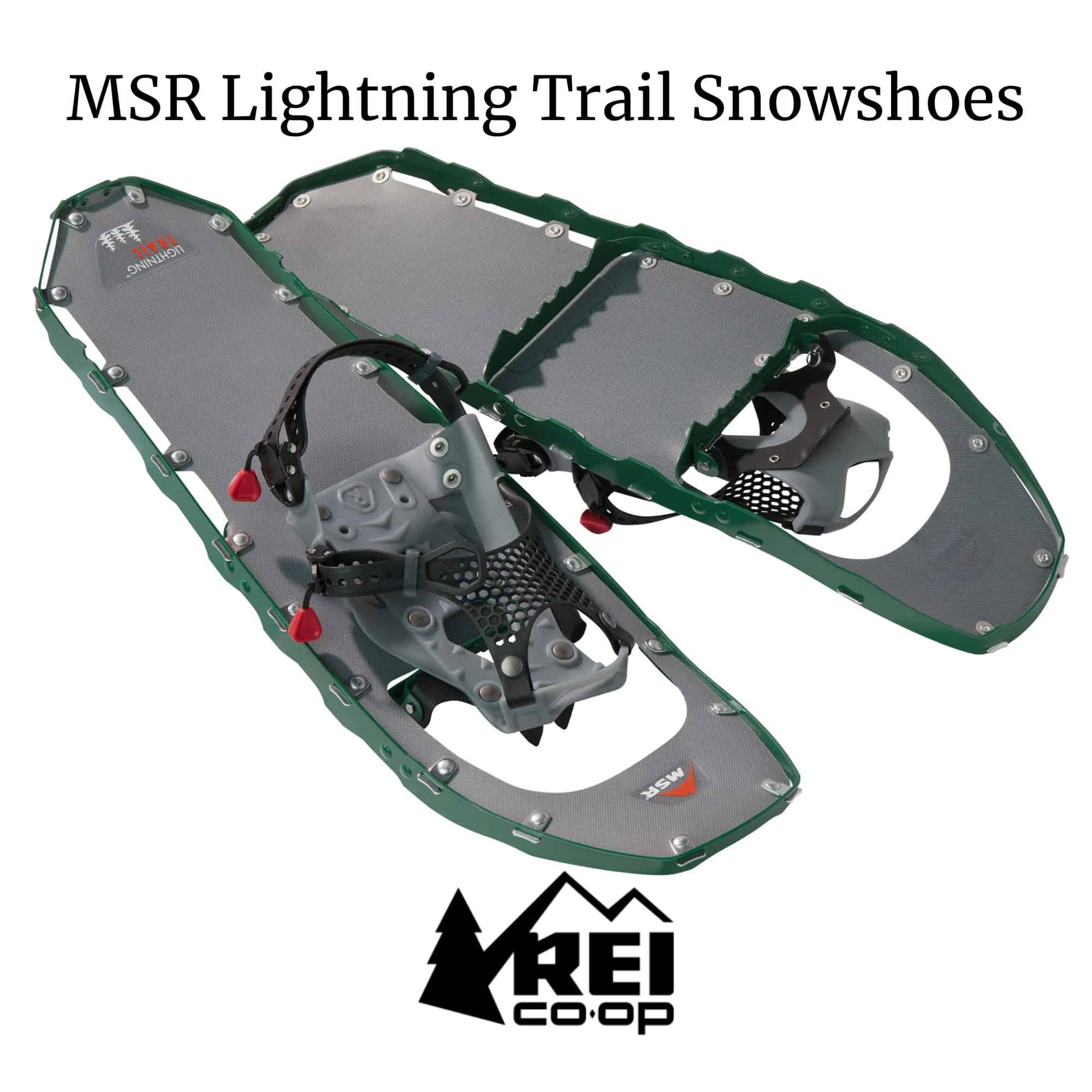
Secondly, if you’re heading out a day or two after a fresh snowfall, snowshoes are an absolute must. Some storms easily dump 1 – 3 feet (0.3 – 1 m) of snow in the mountains. Knowing this difference can make or break a winter hike.
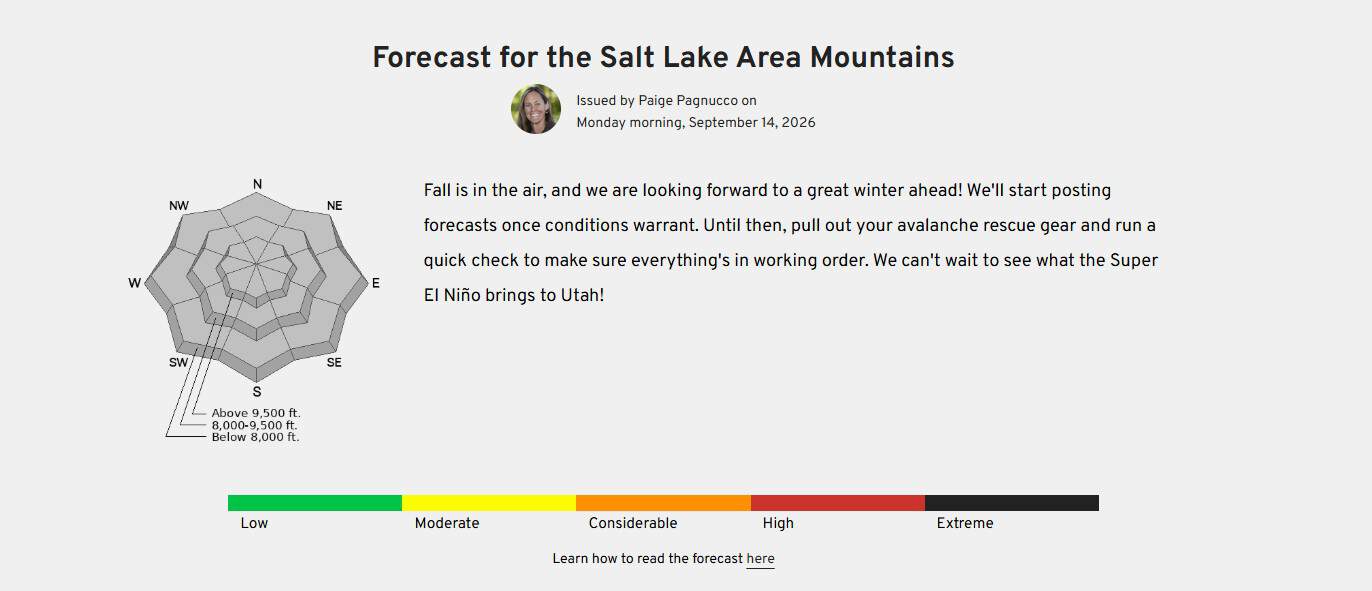
Secondly, always check the Utah Avalanche Forecast, especially if you’re planning to tackle any of the higher-elevation routes, which I will denote. My rule? If I see anything other than green on the diagram below, I avoid hikes above 8,000 feet (2439 m). You can also download the Utah Avalanche Center App to check conditions on-the-go!
My Mistakes:
So why did I hate winter hiking at first? On my first outing, I wore cheap, bulky, and restrictive snow pants, dragged heavy snowshoes across a completely packed-down trail, where Microspikes would be more appropriate, and forgot to check the forecasted temperature.
The following year, I hiked Frary Peak on Antelope Island with crampons instead of Microspikes. The thick, sharp blades on crampons are seriously overkill for the light snow Antelope Island usually gets; they’re built for steep, technical mountaineering routes. Knowing what to use and when is a serious game changer.
Easy Hikes: Foothill Trails (Lower Snow)
The first five hikes on this list are family-friendly and perfect for anyone looking to get into winter hiking. Trail conditions can vary significantly based on snowpack, temperature, and recent weather, so be sure to check AllTrails before heading out.
Winter inversions are common from mid-November through late February. While they can create beautiful views from above, the air quality below can be poor. I recommend checking local air quality conditions. When air quality is orange or red, head up the canyons instead, where you can hike above the inversion layer
1. Ensign Peak
Ensign Peak is a local favorite and one of my favorite winter hikes near Salt Lake City! Located just a few minutes’ drive from downtown, this short but steep trail rewards you with sweeping views of the Salt Lake Valley, framed by the city skyline and the snow-capped Wasatch Mountains.
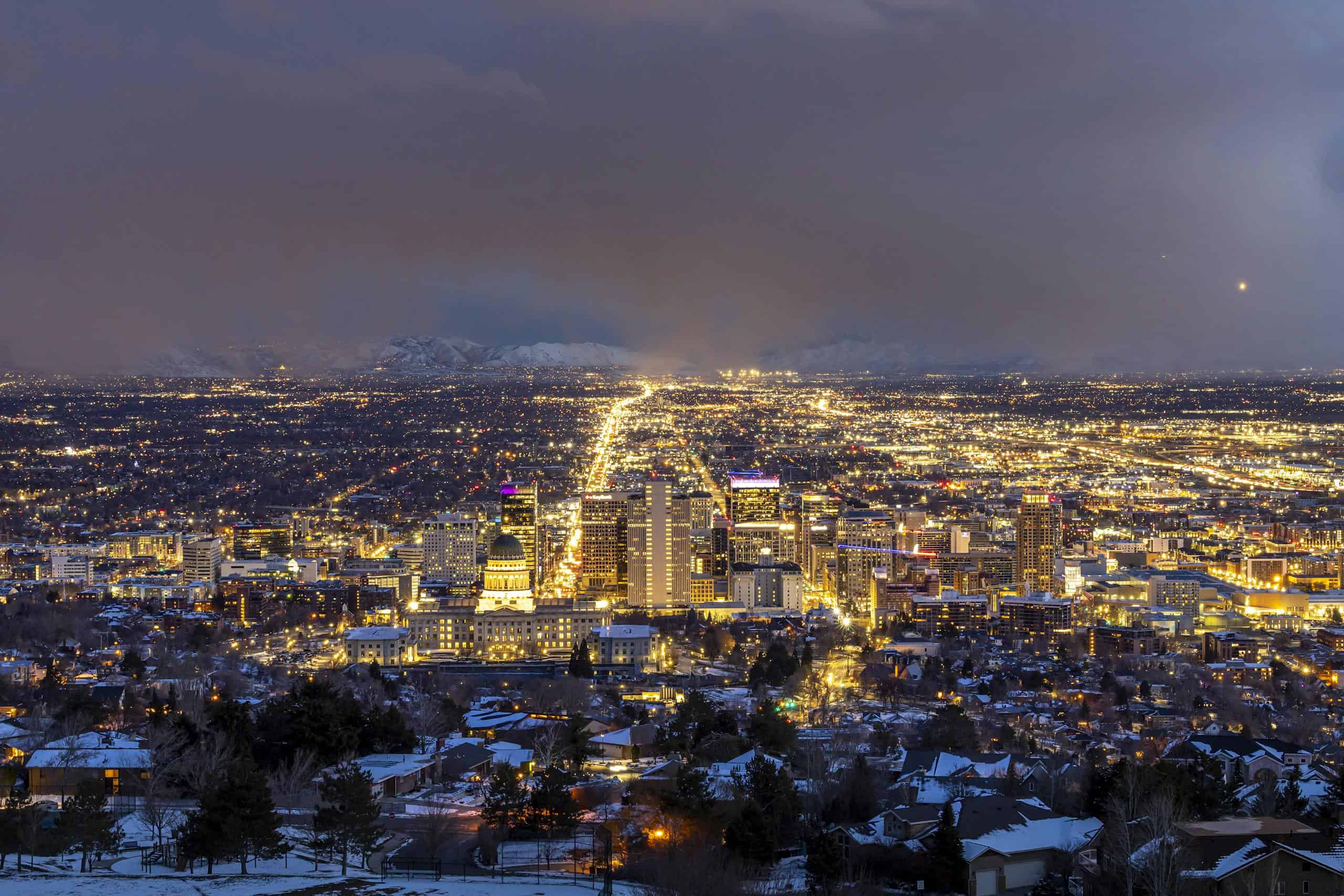
While winter conditions can be difficult to predict, the trail is often either muddy or icy. Check AllTrails for the latest trail conditions and don’t forget to pack your Microspikes just in case! If the trail is muddy, I recommend choosing one of the canyon hikes listed below instead, as hiking through mud can accelerate erosion and damage the trail.
2. The Living Room
The Living Room is a short but steep hike above the Red Butte Gardens at the University of Utah. While the view of Salt Lake Valley from the top is stunning, the hike is unique for the famous “living room” made from sandstone slabs.

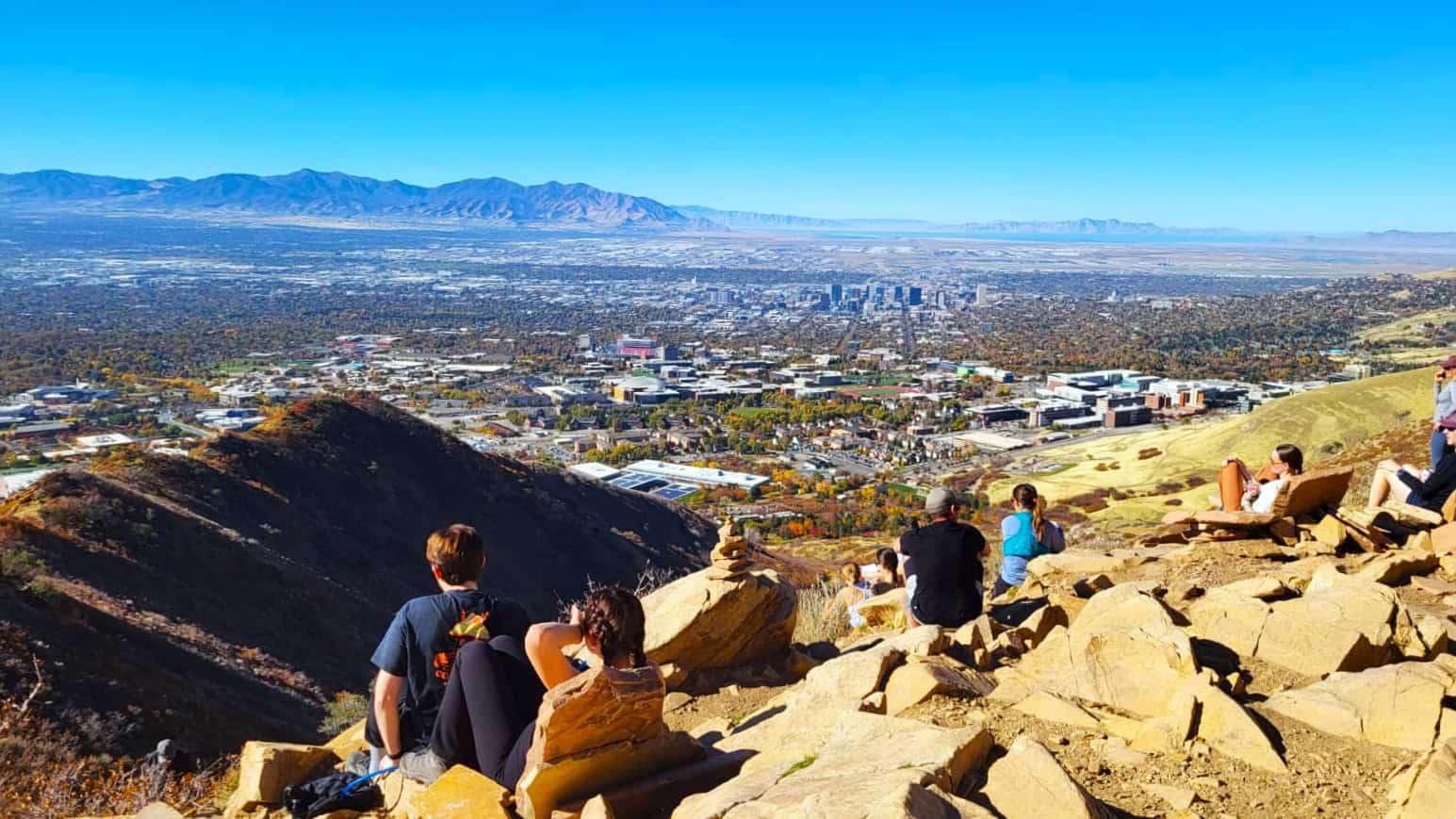
Essentially, you’ll find flat rock slabs arranged by hikers over the years to resemble reclining chairs that you can sit on! I wish my own living room had these views! In winter, the trail can get icy or muddy, so microspikes are recommended. The open and exposed landscape means you’ll feel the wind, but the payoff is worth it
3. Bonneville Shoreline Trail
The Bonneville Shoreline Trail is an ambitious project that one day aims to span the entire length of the Wasatch Range, a 280-mile (451 km) continuous trail. As the name suggests, the trail follows the shoreline of a massive lake. But what lake?
Thousands of years ago, Lake Bonneville covered much of western Utah, including the Salt Lake Valley, and reached depths of more than 1,000 feet. Its ancient shoreline can be traced along the foothills of the Wasatch Mountains, which this route roughly follows.
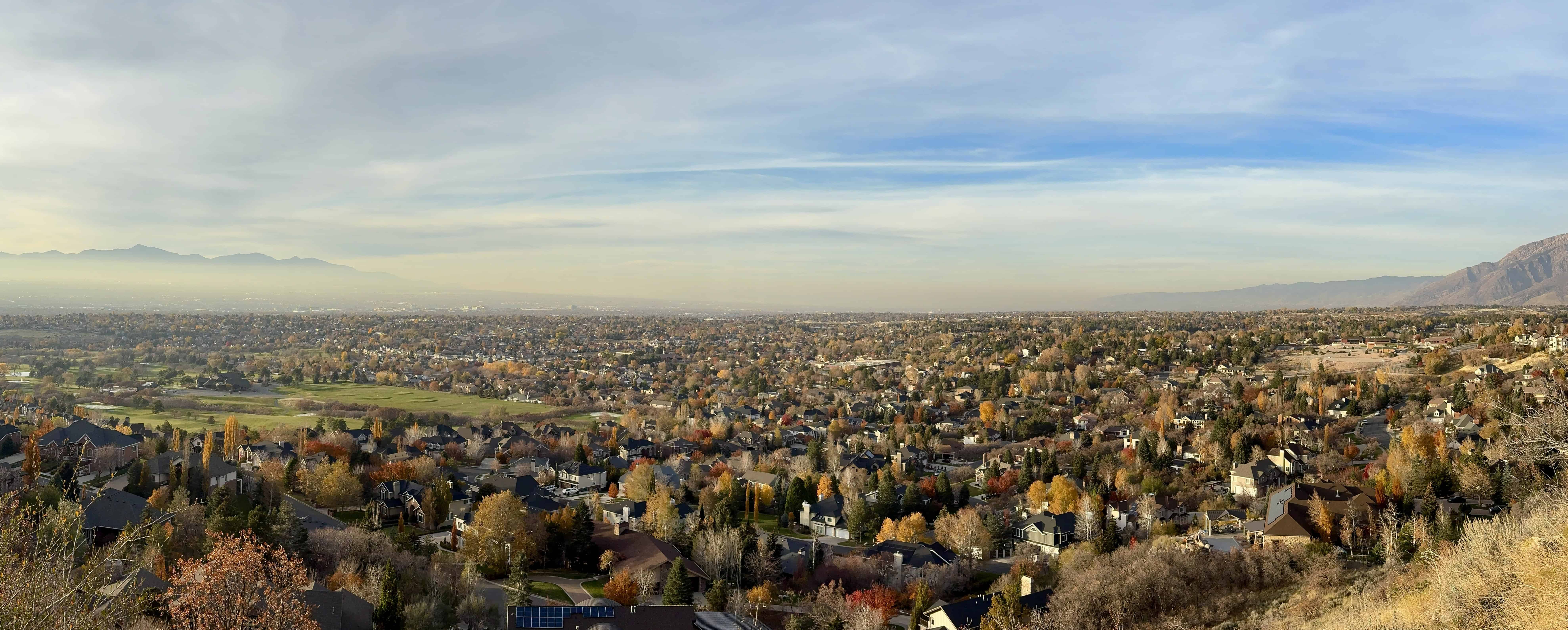
Because of the numerous access points, hikes can be as short or as long as you’d like! Averaging around 5,000 feet (1524 m) in elevation, it’s a perfect trail to explore in winter, with no avalanche danger and open views! As always, be sure to pack Microspikes for icy conditions.
4. Bear Canyon Suspension Bridge
This classic, family-friendly hike leads to a wooden suspension bridge built in 2015 that spans a seasonal creek in Bear Canyon. During winter, the creek may be frozen or only lightly flowing. Icy conditions are common along this route, so I recommend bringing Microspikes even though this is considered an “easy” hike.
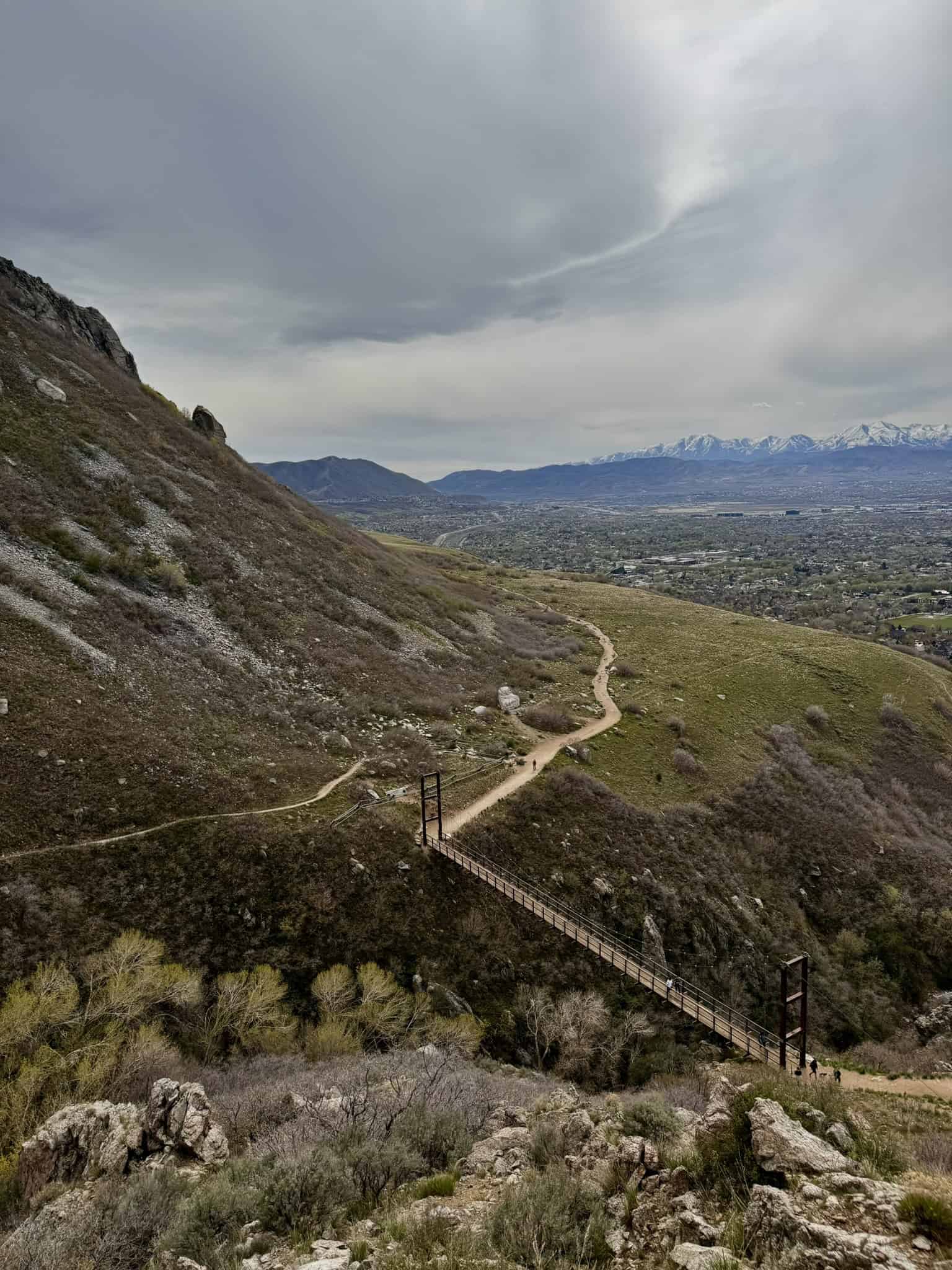
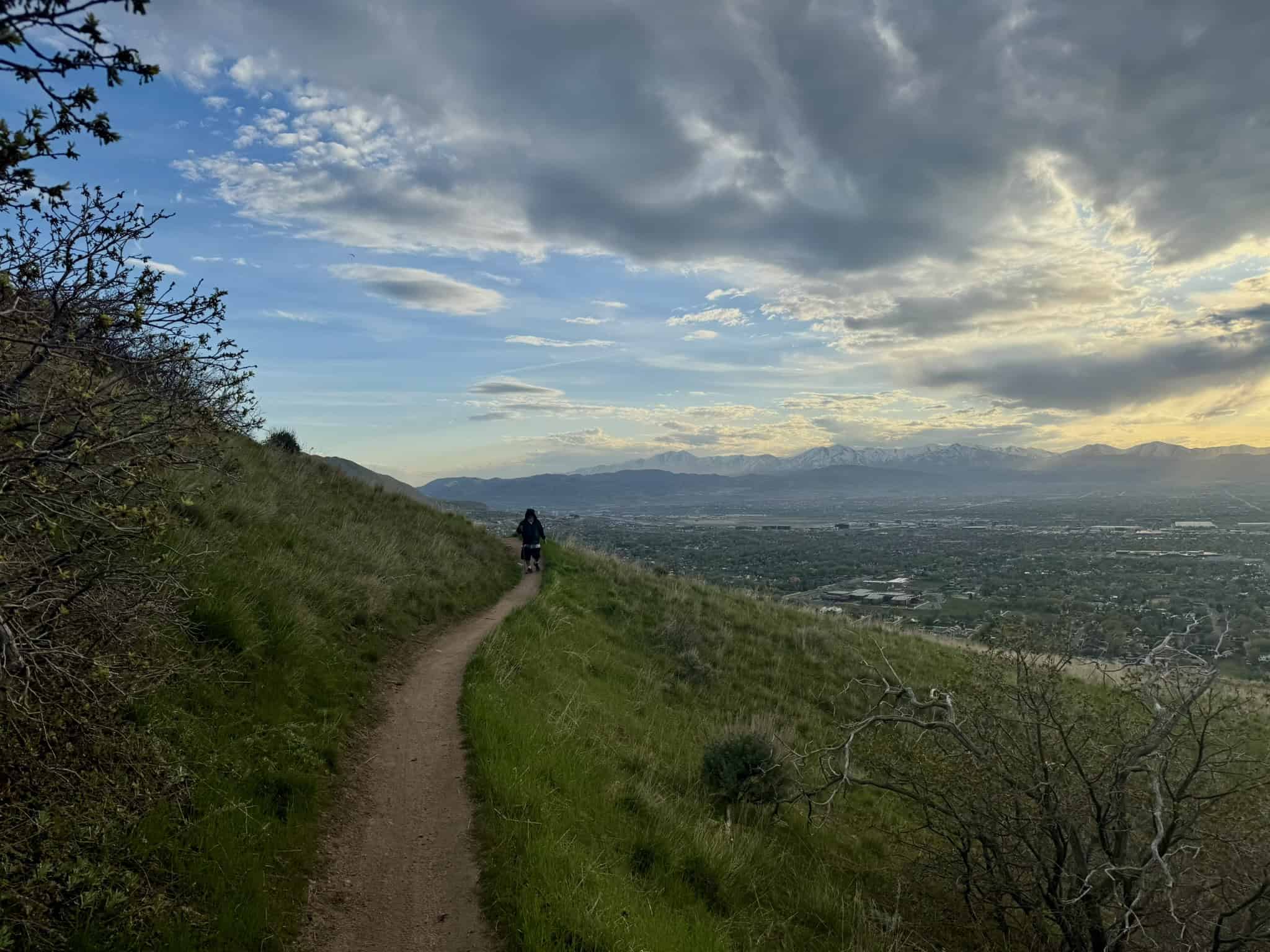
For an even better experience, continue north of the bridge and climb the steep hillside for an aerial view of the suspension bridge below. This is known as the “Bear Loop.” From there, descend toward the smaller bridge in Bear Canyon before looping back to the suspension bridge.
Pro Tip: I prefer starting from Hidden Valley Park, which extends the hike about 1.5 miles (2.4 km) round trip along the shoreline trail with beautiful views of the Salt Lake Valley!
5. Avenue Twin Peaks
Of the three “Twin Peaks” in the Wasatch Mountains, the Avenue Twin Peaks are the most accessible in Winter. The trail climbs steadily above the city, rewarding your efforts with sweeping panoramic views of the Salt Lake Valley, the Great Salt Lake, and the surrounding Wasatch Range.
Winter adds a new level of beauty to the experience. The snow-blanketed foothills contrast against taller snow-capped mountains, creating a stunning backdrop. The city below often falls under a blanket of winter haze. Trail conditions can vary from packed snow to ice, so Microspikes are highly recommended.
Moderate Hikes: Canyon And Waterfall Trails
These next six hikes are perfect for those looking for a bit more of an adventure without needing any technical gear. These hikes get tracked out pretty quickly, so Microspikes are needed, with snowshoes only required after a big snowstorm. With the exception of Bells Canyon, these hikes typically begin above the inversion layer.
6. Bells Canyon Lower Falls
Bells Canyon is one of the most iconic hikes near Salt Lake City, culminating in a stunning 40-foot (12 m) waterfall. As a bonus, Lower Bells Reservoir sits a mere 30 minutes into the hike, a popular stopping point for many looking for a shorter outing.
The trail climbs steadily until the final 1/3 mile (1/2 km), where the trail steepens considerably! Keep an eye out for a small sign marking a sharp left onto a well-worn path that leads to the base of the falls. I really hope the trail gets maintained someday; for now, it’s pretty worn out, so watch your step and use caution.
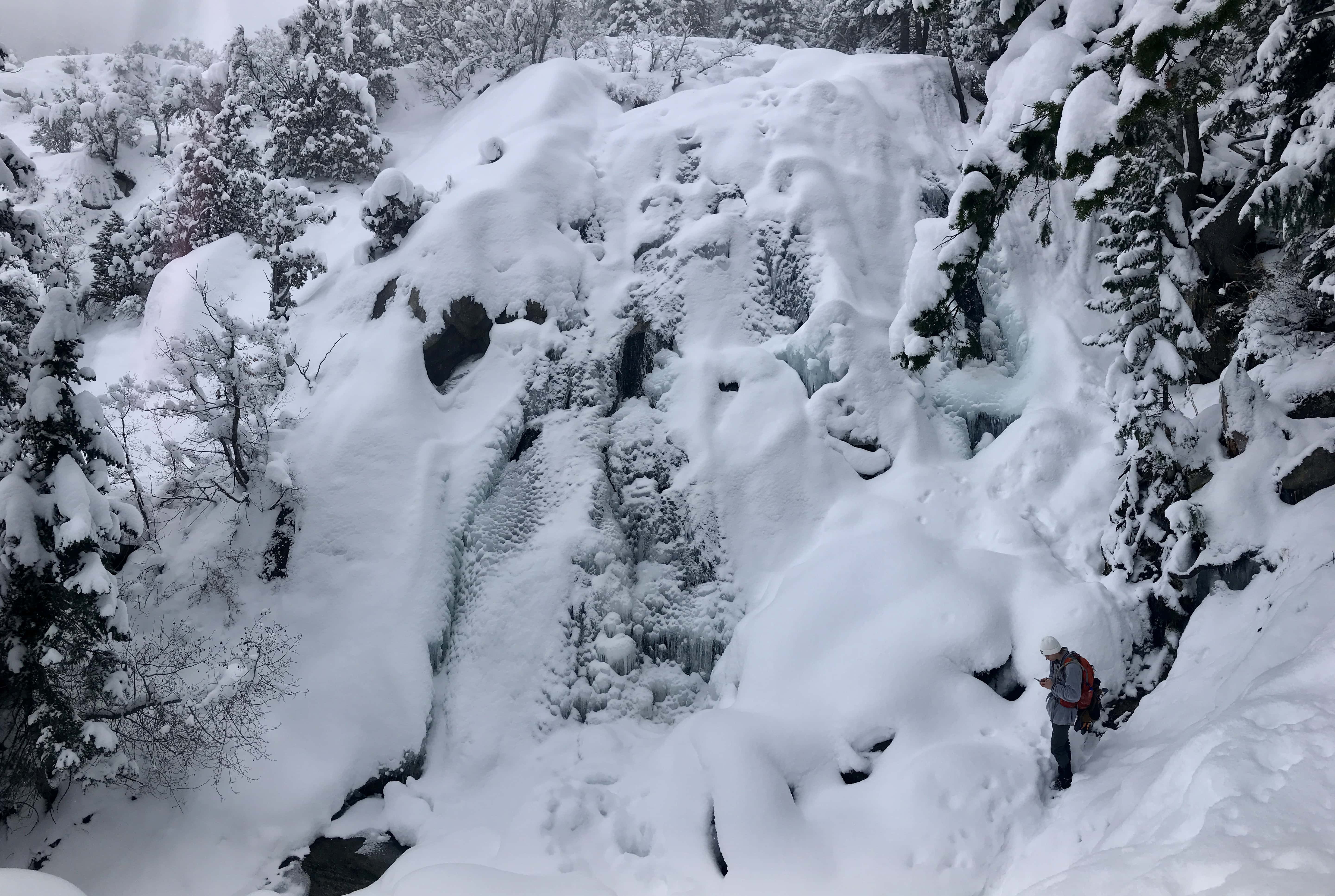
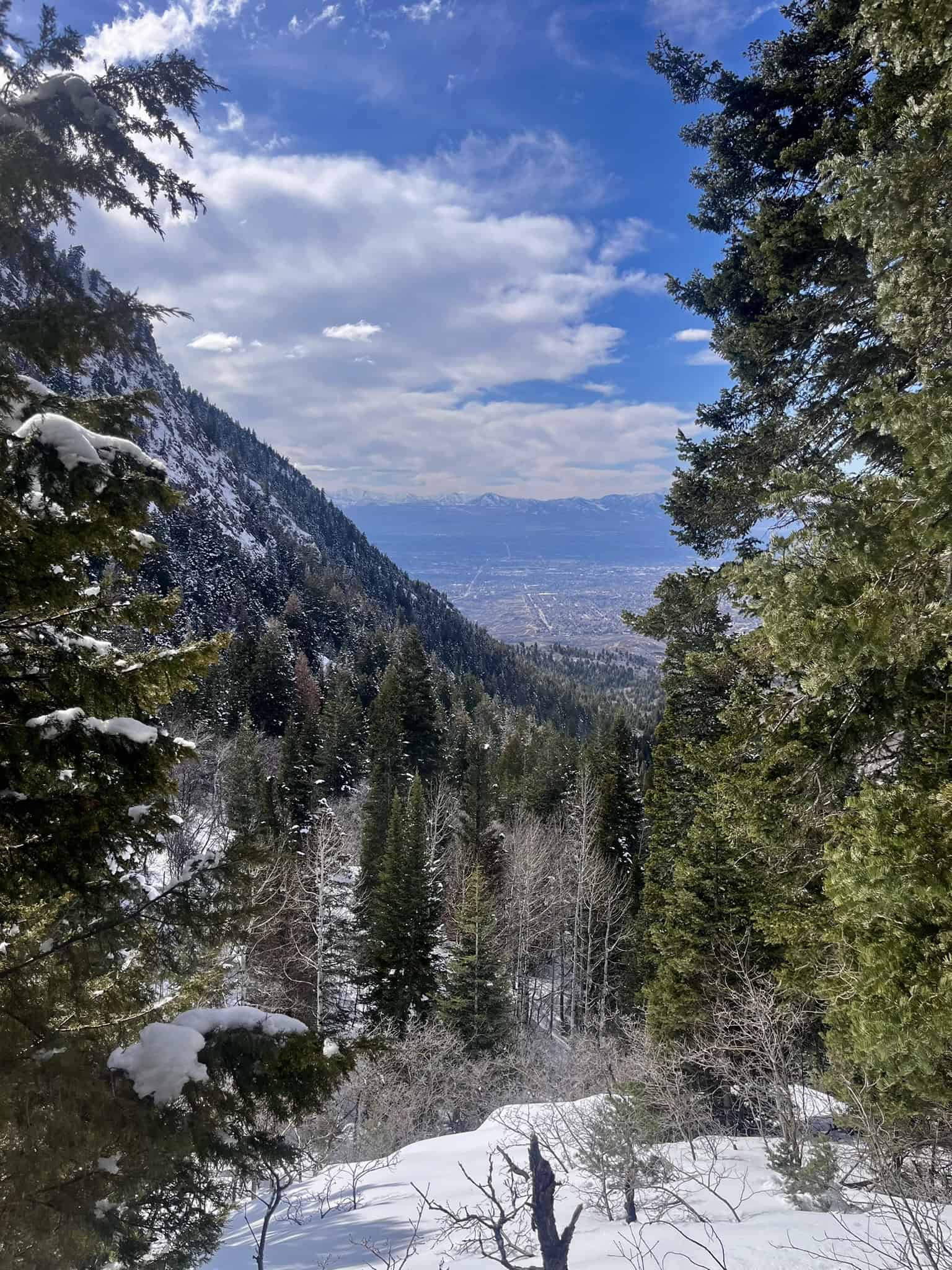
In winter, the trail is often snowy and icy, and the frozen waterfall is an absolutely stunning sight, but don’t forget your microspikes! I personally know someone who hurt their back slipping on this hike without proper traction.
Subscribe Here!
If you’re enjoying this content, sign up for My Weekly newsletter!
7. Donut Falls (Big Cottonwood Canyon)
Famous for the natural rock grotto through which the creek falls, Donut Falls is a popular hike in the summer but transforms into a winter wonderland without the crowds. The trail gets packed down fast, but heavy snowstorms can dump feet of snow, requiring snowshoes.
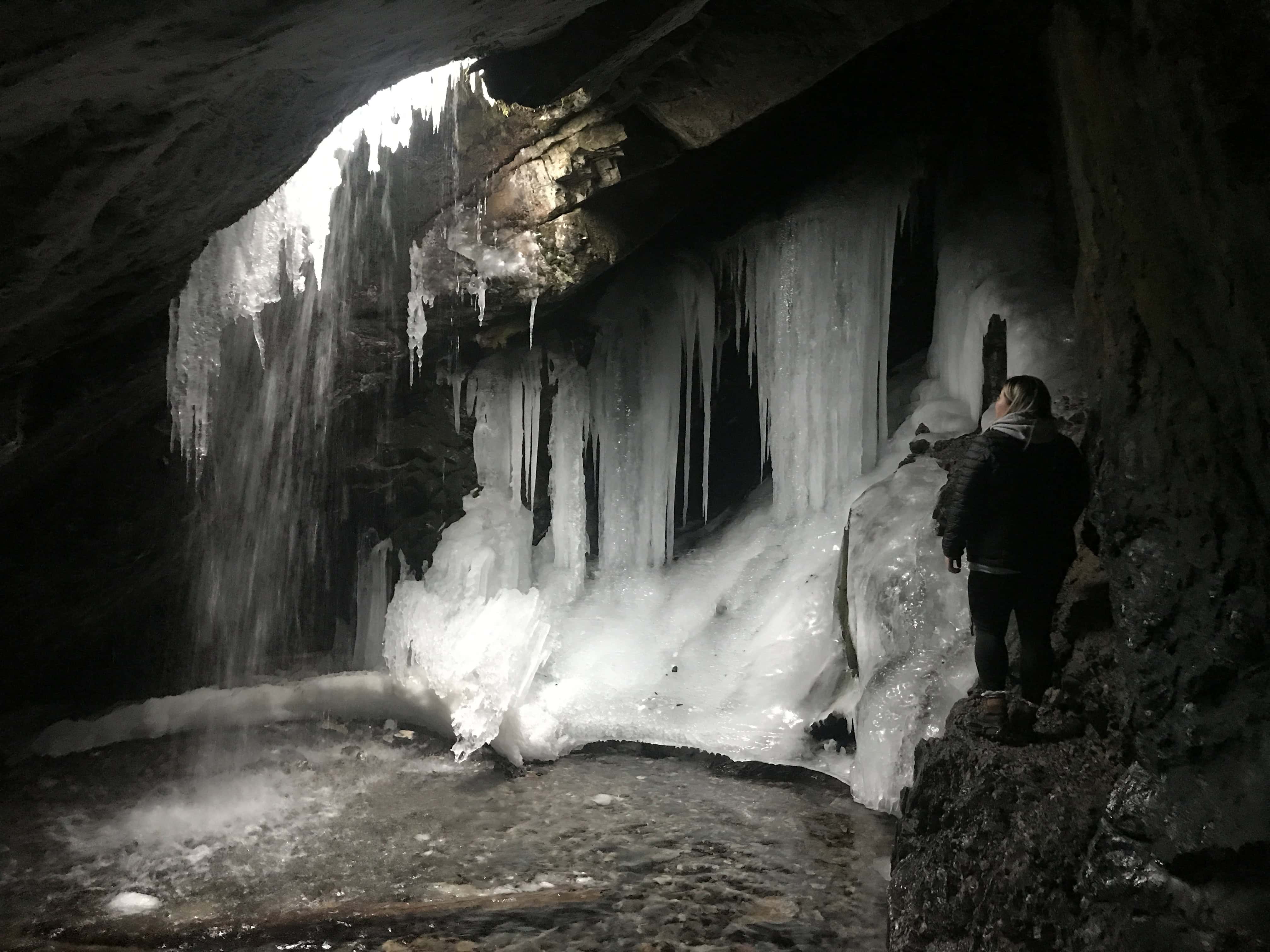
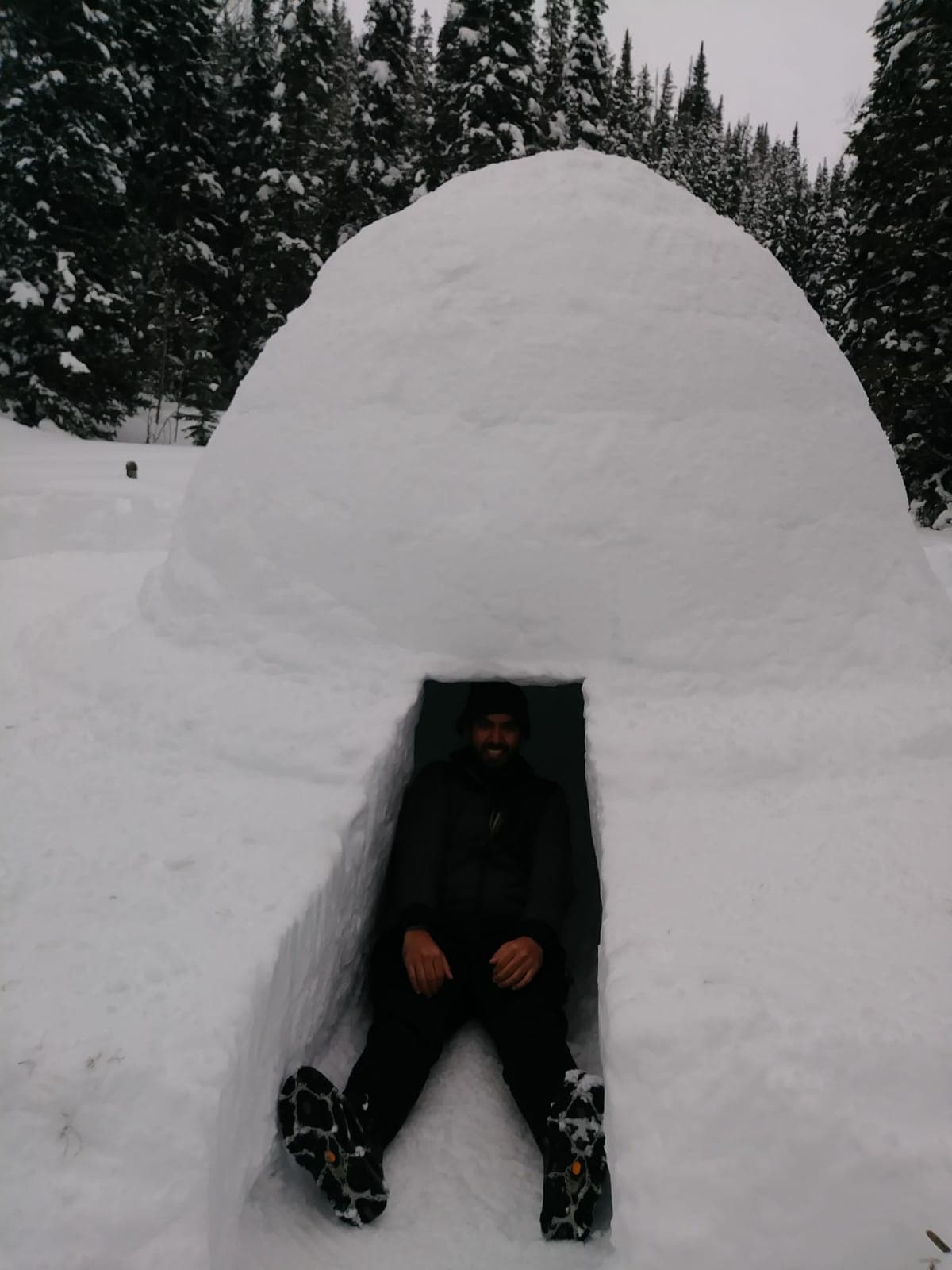
The climb up to the “donut” itself can be icy and slippery, so bring Microspikes. When the snow is deep enough, the rocks that you’d normally scramble up get buried. The waterfall itself is usually partially frozen with icicles. The summer trailhead is also inaccessible, adding about 1 mile (1.6 km) of hiking (one-way), which also helps reduce the crowds.
8. Mill B North (Big Cottonwood Canyon)
For years, this was my go-to hike whenever I needed a quick escape from reality. The trail is relatively short, but the payoff is huge, with spectacular views of several Wasatch 11’ers and Mill B South Fork, home to the famous Lake Blanche.
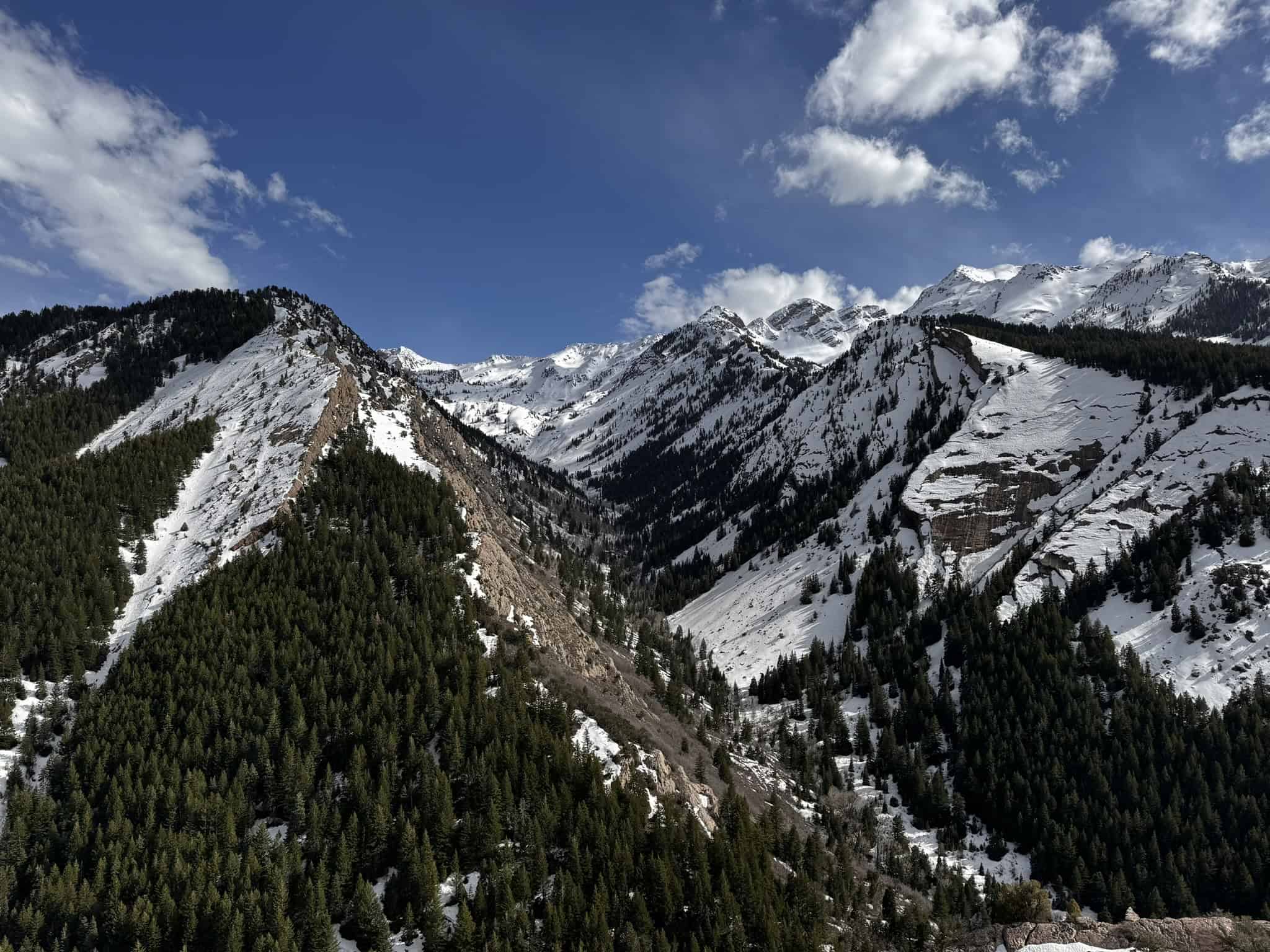
This trail tends to be icy most of the winter, so pack your Microspikes! After a set of initial switchbacks, the trail levels out before hitting a second set of longer switchbacks. From here, you’ll see a marked sign leading to a rocky outcrop, from which you’ll be treated to the panoramic views you set out for!
9. Gloria Falls (Little Cottonwood Canyon)
Gloria Falls is a stunning, multi-tiered waterfall tucked away in Little Cottonwood Canyon. The trail to the falls can get pretty icy in early winter, as other hikers often track it out. Due to its location, snowfalls can be heavy, so snowshoes are required after a storm. The view of the waterfall frozen waterfall is well worth the trek!
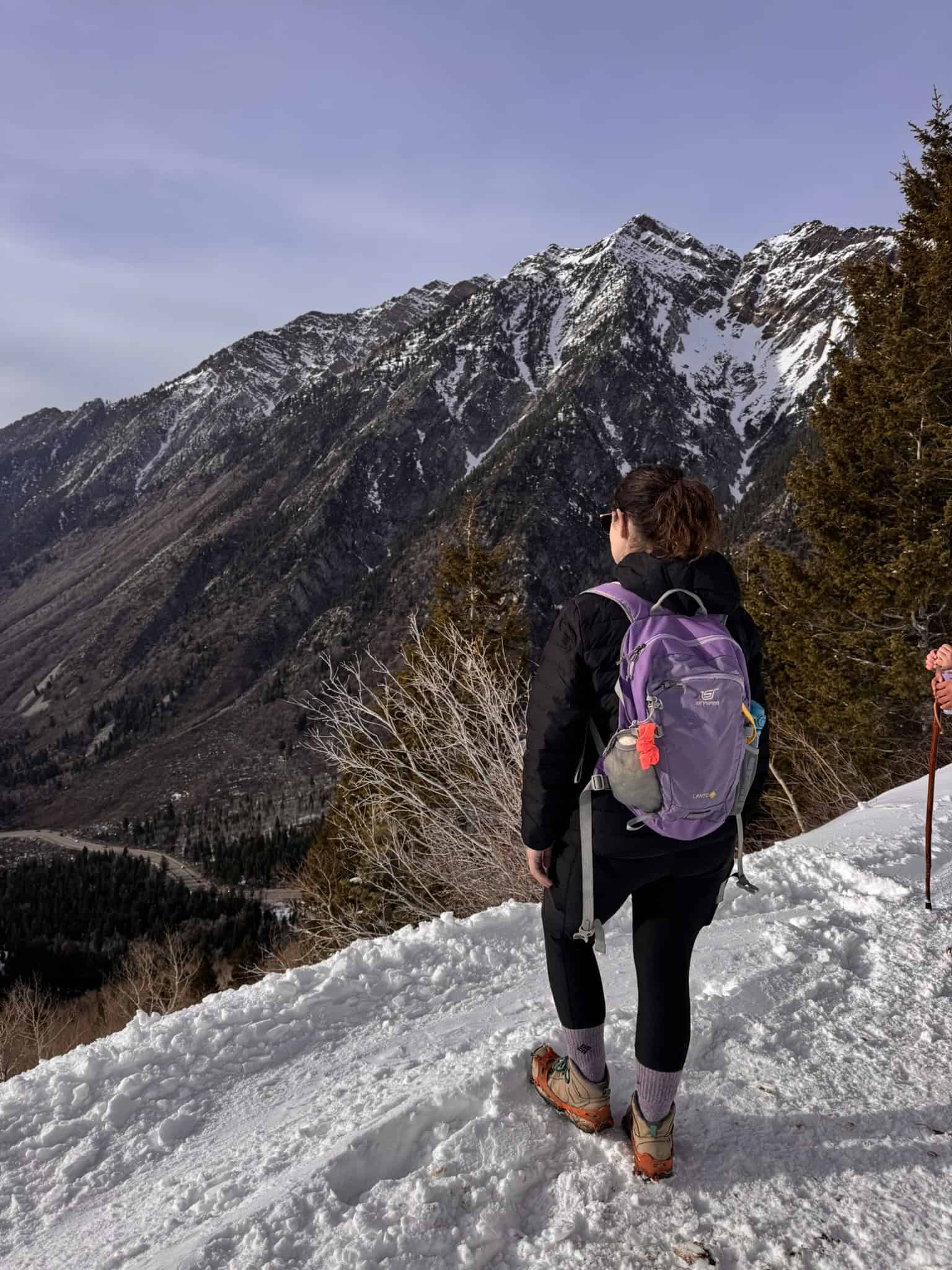
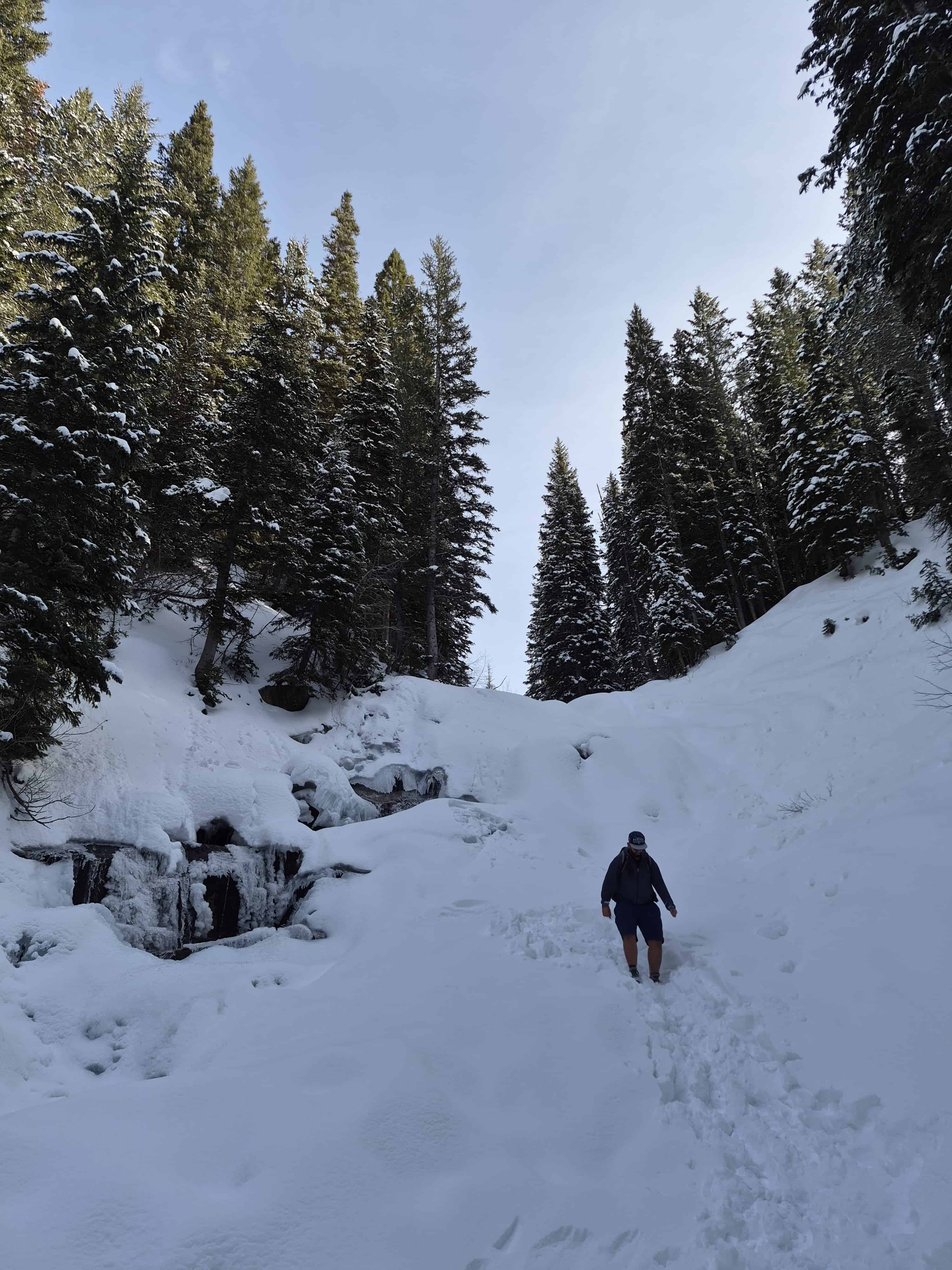
As of 2026, an official summer route is in the works. In winter, you’ll follow the existing trail as closely as possible. At roughly the 1-mile (1.6 km) mark along the Red Pine Lake Trail, you’ll cross a bridge and then take a left. This short detour takes you to the waterfall.
Pro Tip: After checking out Gloria Falls, head back onto the Redpine Trail and push another ~0.5 miles (0.8 km) to the Little Cottonwood Canyon overlook. It’s a short detour that adds an incredible payoff to the day!
10. Desolation Trail to Salt Lake Overlook (Millcreek Canyon)
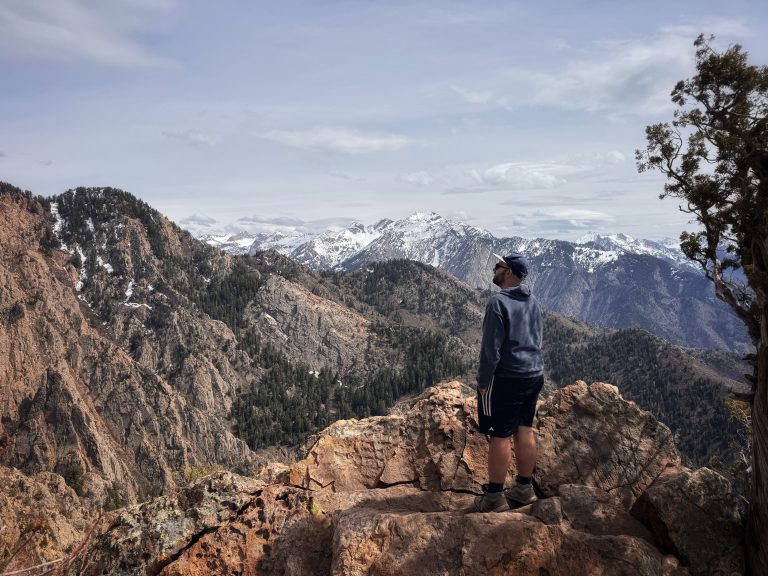
The Desolation Trail to Salt Lake Overlook was one of my winter favorites for a few years in a row before I decided to switch it up! This hike in Millcreek Canyon offers stunning views of the Salt Lake Valley from a rocky outcrop, perfect for photo-ops!
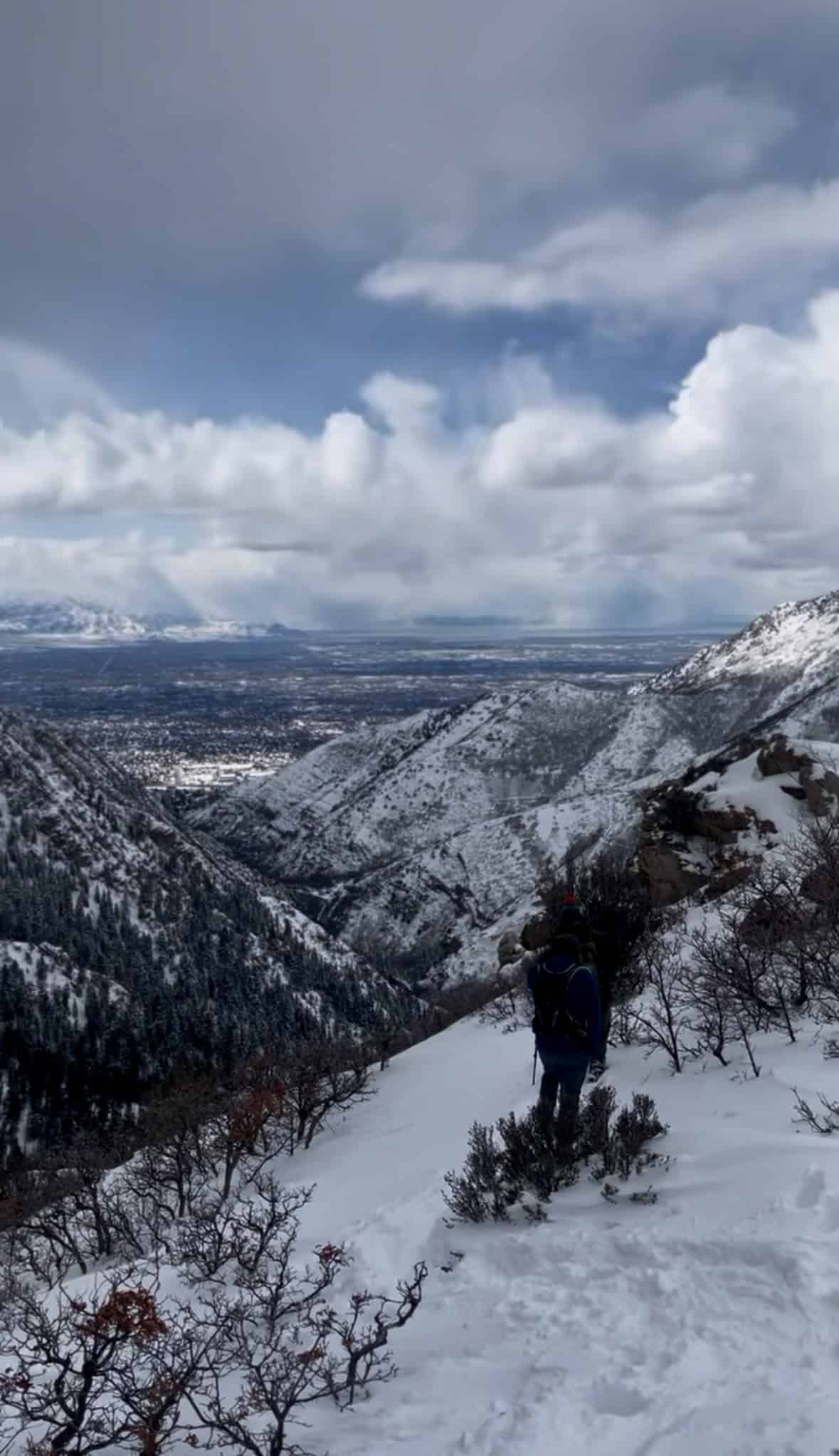
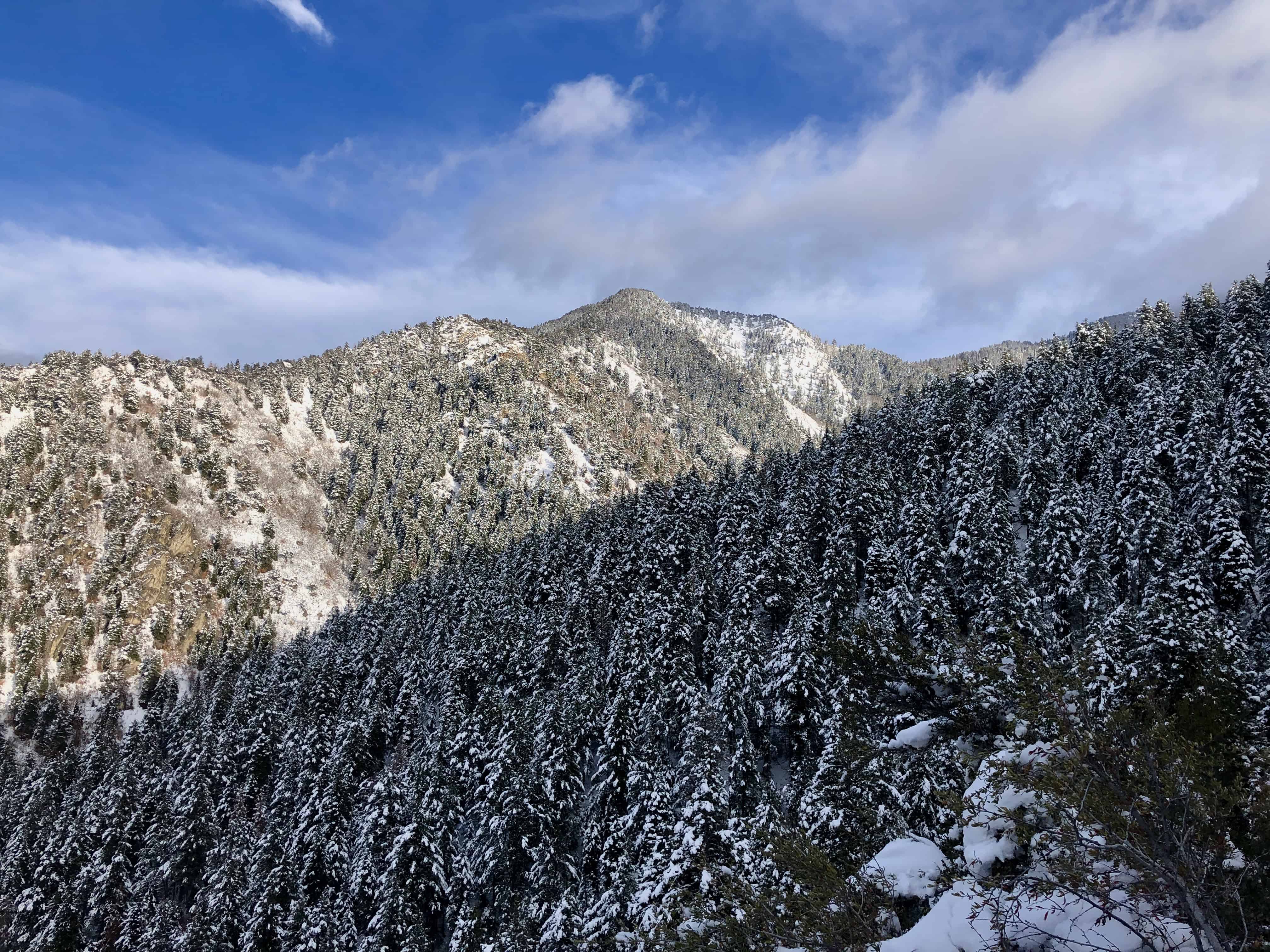
The trail follows the north slope, so it is very shaded and, in winter, can be very icy. Be sure to wear microspikes, which may be starting to sound like a theme now! The majority of the hike consists of long, seemingly endless switchbacks up the mountain. However, the overlook at the end is well worth the effort, especially in Winter!
11. Pipeline Trail to Salt Lake Overlook (Millcreek Canyon)
Another Wasatch Mountain classic, this hike offers stunning views of the Salt Lake Valley and Mount Olympus! In winter, expect snow and ice covering the trail, especially on the steep initial climb, but with the south-facing slopes, the trail is more often muddy than icy.
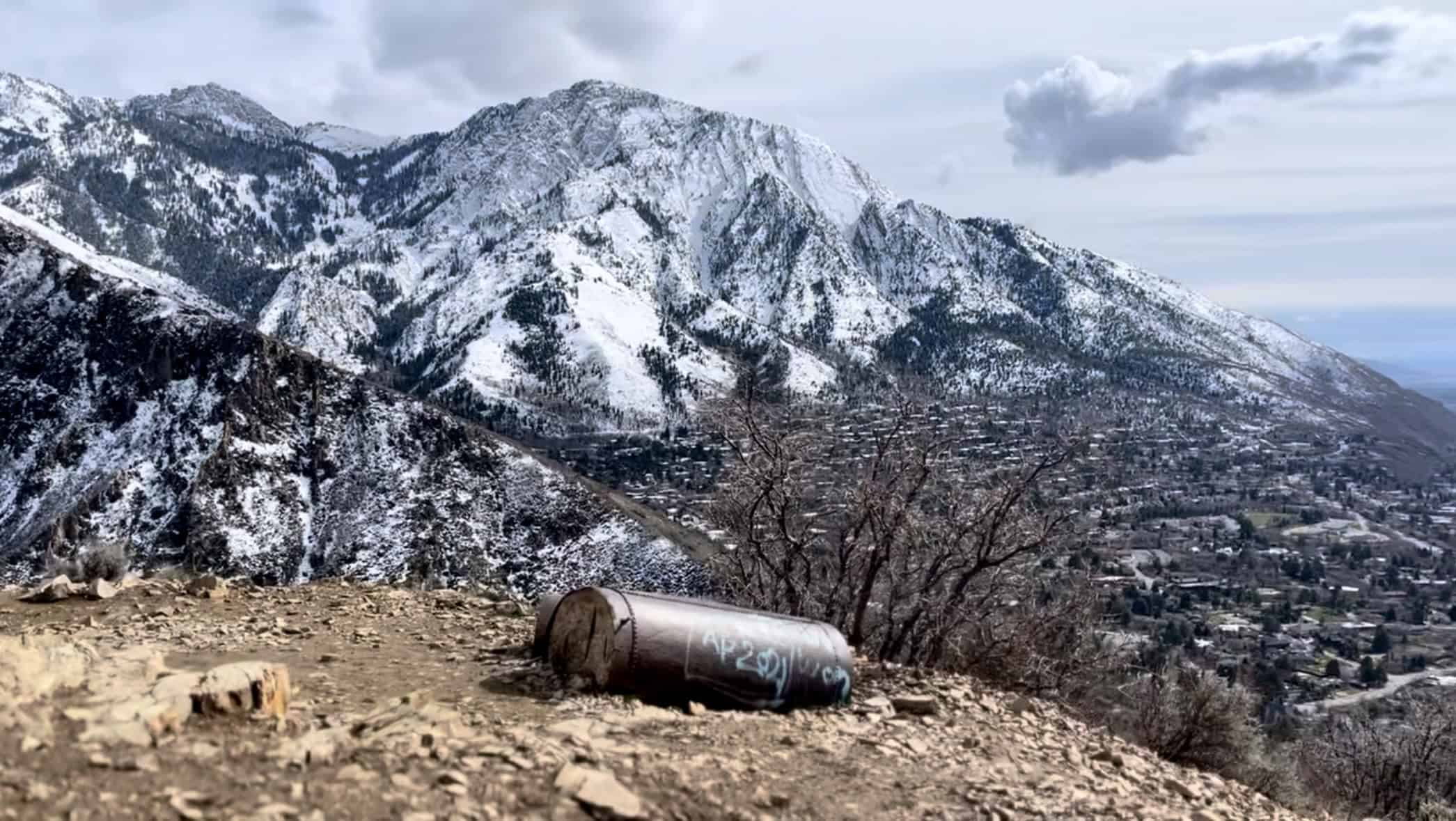
The hike starts at Rattlesnake Gulch, where you climb about 800 feet of elevation in the first 1 mile (1.6 km) before walking about 1 mile (1.6 km) along the flatter Pipeline Trail to the overlook. This view is especially stunning right at sunset!
Difficult Hikes: Peaks And Lakes
To finish off this list, we will be exploring some of the toughest, non-technical winter hikes near Salt Lake City with minimal avalanche danger. These hikes can be completed by hikers looking for adventure without venturing into mountaineering. Let’s go!
12. Grandeur Peak (Millcreek Canyon)
Like Mount Olympus, I find myself hiking Grandeur Peak more in the winter than summer because of the lack of heat and crowds. It is a low-avalanche risk hike with views that rival much higher elevation mountains! As always, Microspikes are highly recommended when it’s icy, but after a fresh snowfall, snowshoes are better.
This hike begins at the Church Fork Picnic Area, and in winter, you have to park on the road and walk the extra 1/3 mile (1/2 km) to the summer trailhead. From here, the first mile (1.6 km) climbs steeply through an old-growth pine forest before opening up into stunning views along the switchbacks!

The final 0.75 mile (1.2 km) steepens once again as the final push makes you work hard for the views! In late winter, the snow on the final push can be very deep, but somewhat manageable without snowshoes.
13. Mount Olympus
Mount Olympus is the toughest hike on this list, but it rewards you with one of the best winter views in the Wasatch Range without requiring technical climbing skills. The trail becomes relentlessly steep in the second half and culminates in a final scramble of roughly 600 vertical feet.
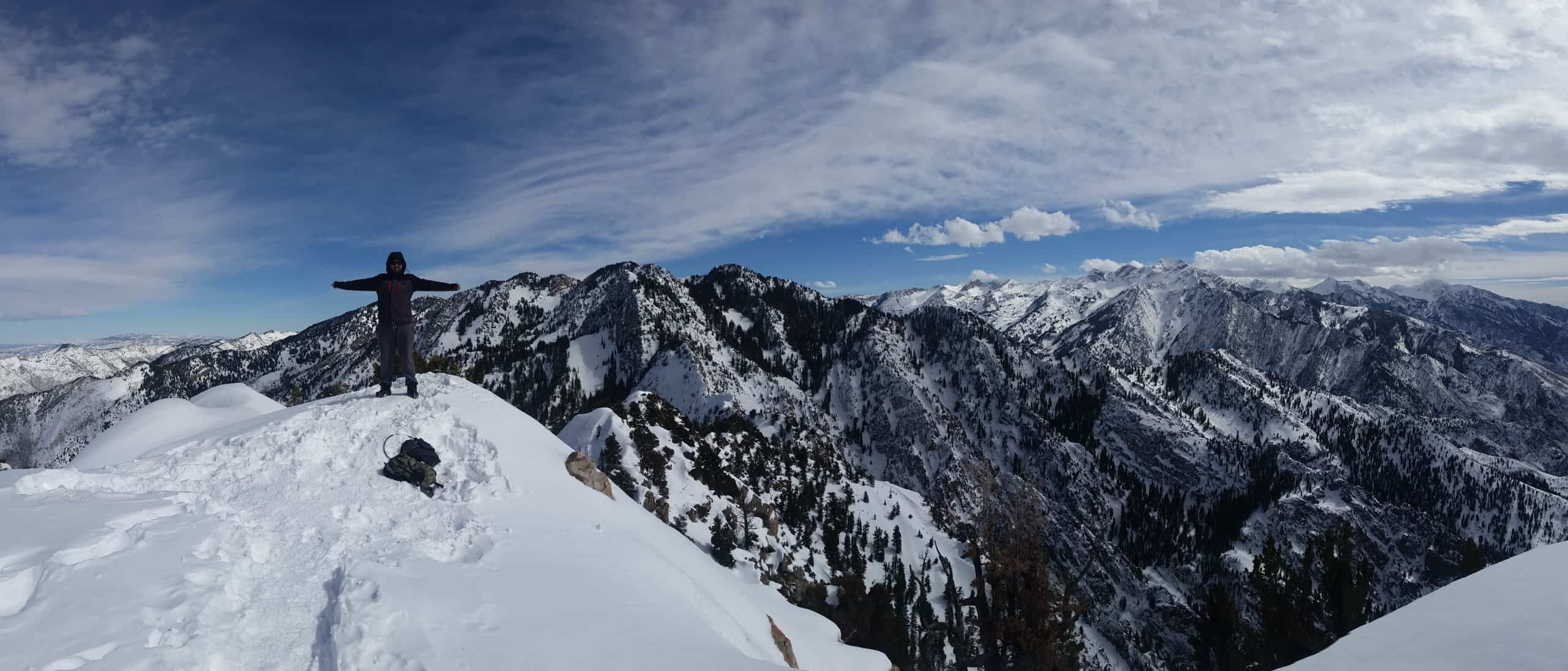
This final section can be tricky as the south-facing slope melts during the day and refreezes overnight, creating icy conditions. In my experience, Mount Olympus is best hiked in early winter (November through December) or late winter (February through March), when the snow is deep enough and Microspikes are effective.
The effort is substantial, but the panoramic views from the summit make it well worth it. In fact, I prefer hiking Mount Olympus in Winter over the mid-summer heat!
Pro-Tip: Some may argue Crampons are necessary for the final section, but I’ve been able to scramble up the ice with Microspikes. It all boils down to personal comfort level.
14. Circle All Peak (Big Cottonwood Canyon)
Circle All Peak is a short but consistently steep hike that leads to a minor summit with stunning panoramic views. Every time I’ve summited, I’ve found myself exclaiming “Wow, that is amazing!” The views rival those from nearby Mount Raymond and Gobblers Knob, without the avalanche danger.
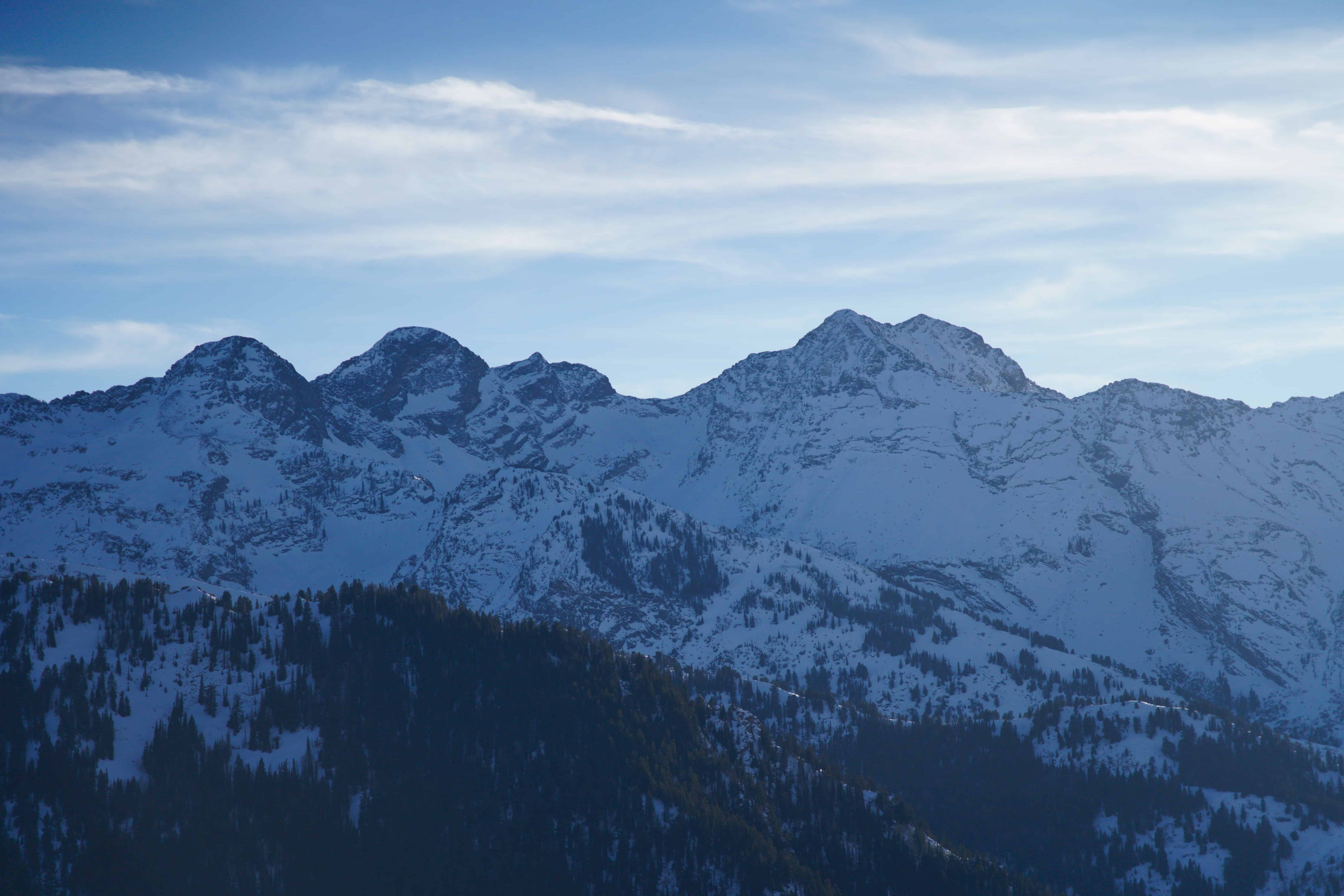
During periods of heavy snowfall, snowshoes may be necessary, although the trail is often well packed thanks to its popularity, requiring Microspikes for increased traction. For hikers looking to build confidence in winter conditions, Circle All Peak offers a rewarding challenge with outstanding views.
Pro Tip: Always check current conditions on AllTrails before setting out.
15. Lake Blanche (Big Cottonwood Canyon)
Lake Blanche is easily the most popular and arguably the most beautiful alpine lake in the Wasatch Mountains! While it’s best known as a summer destination, it also makes for a fantastic winter hike. The trail is significantly more challenging in snow, but the reward is a frozen lake surrounded by snow-covered peaks and far fewer crowds.
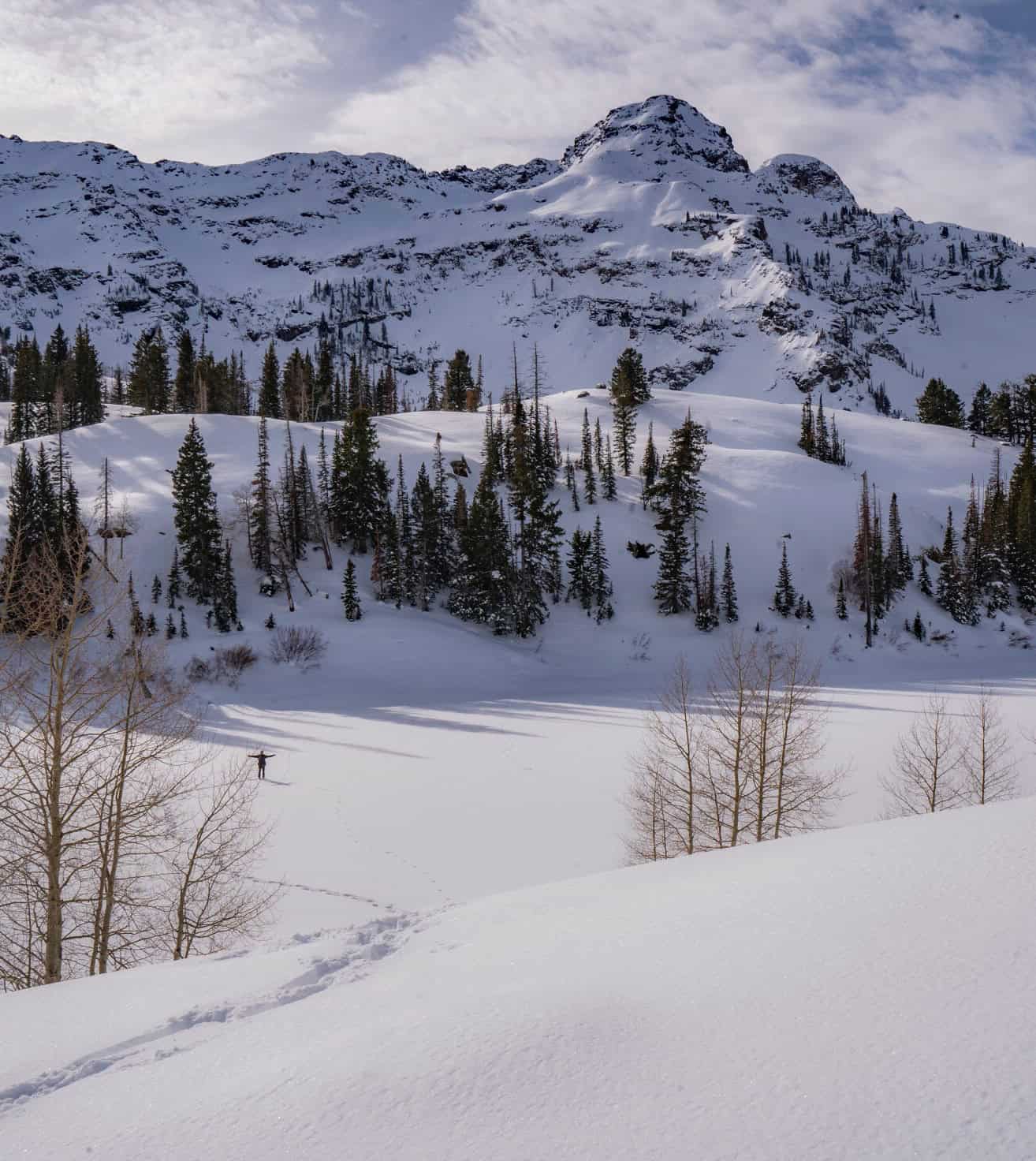
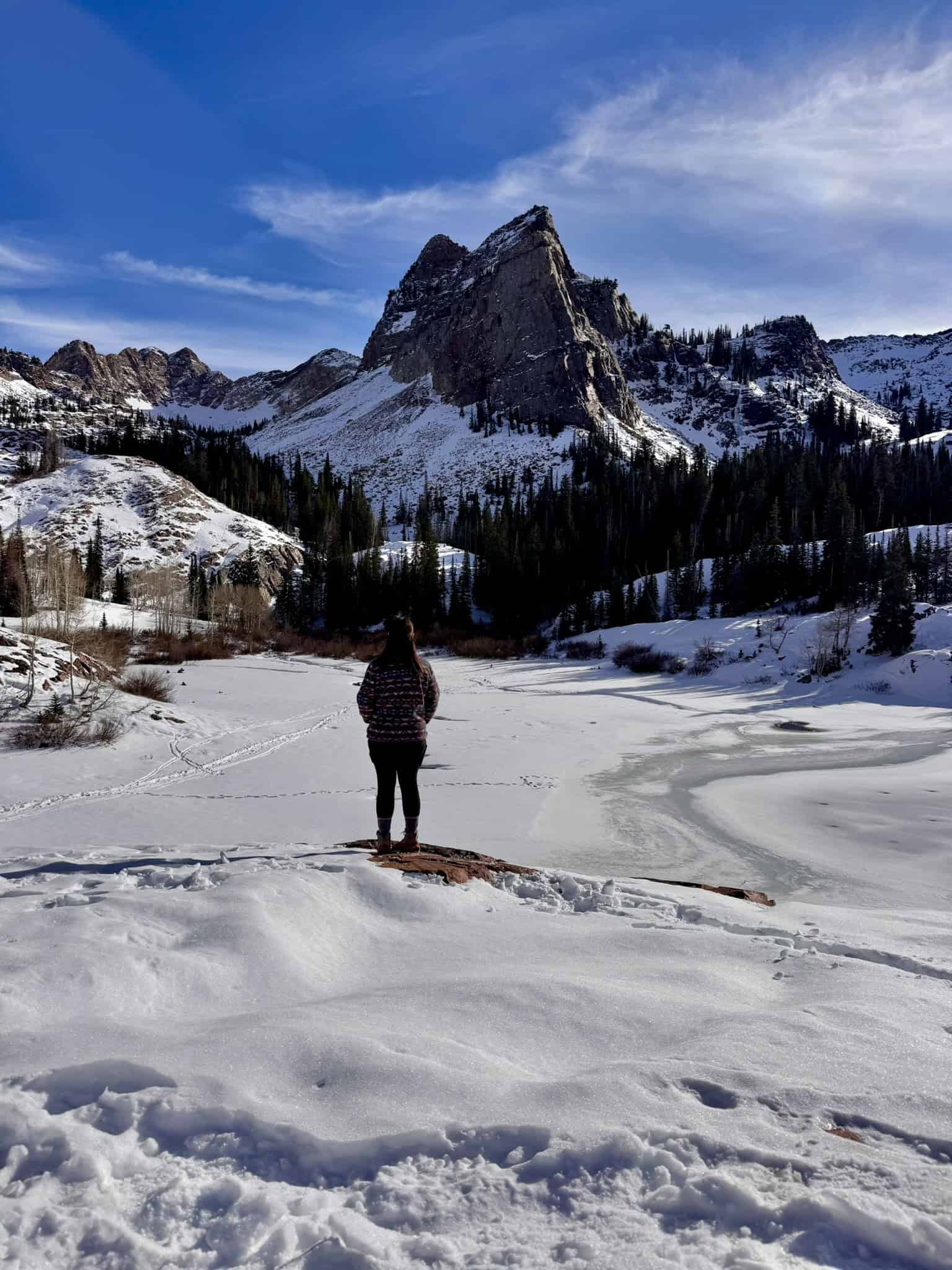
Winter conditions typically bring deep snow, though the trail is often packed down by other hikers, making Microspikes essential. After fresh storms, snowshoes are necessary to stay afloat in Utah’s famous powder.
Note: Just a 1/2 mile (0.8 km) before the lake, the trail passes beneath an avalanche path, so I only recommend hiking it when avalanche danger is low.
16. Broadsfork Meadow (Big Cottonwood Canyon)
Broads Fork sees far fewer hikers than Lake Blanhe, despite sharing the same parking lot. In winter, the meadow with three Wasatch 11‑ers towering above, dressed under a blanket of snow, is quite the sight to see! While Microspikes are necessary in early winter, large storms create ideal conditions for snowshoeing and cross-country skiing!
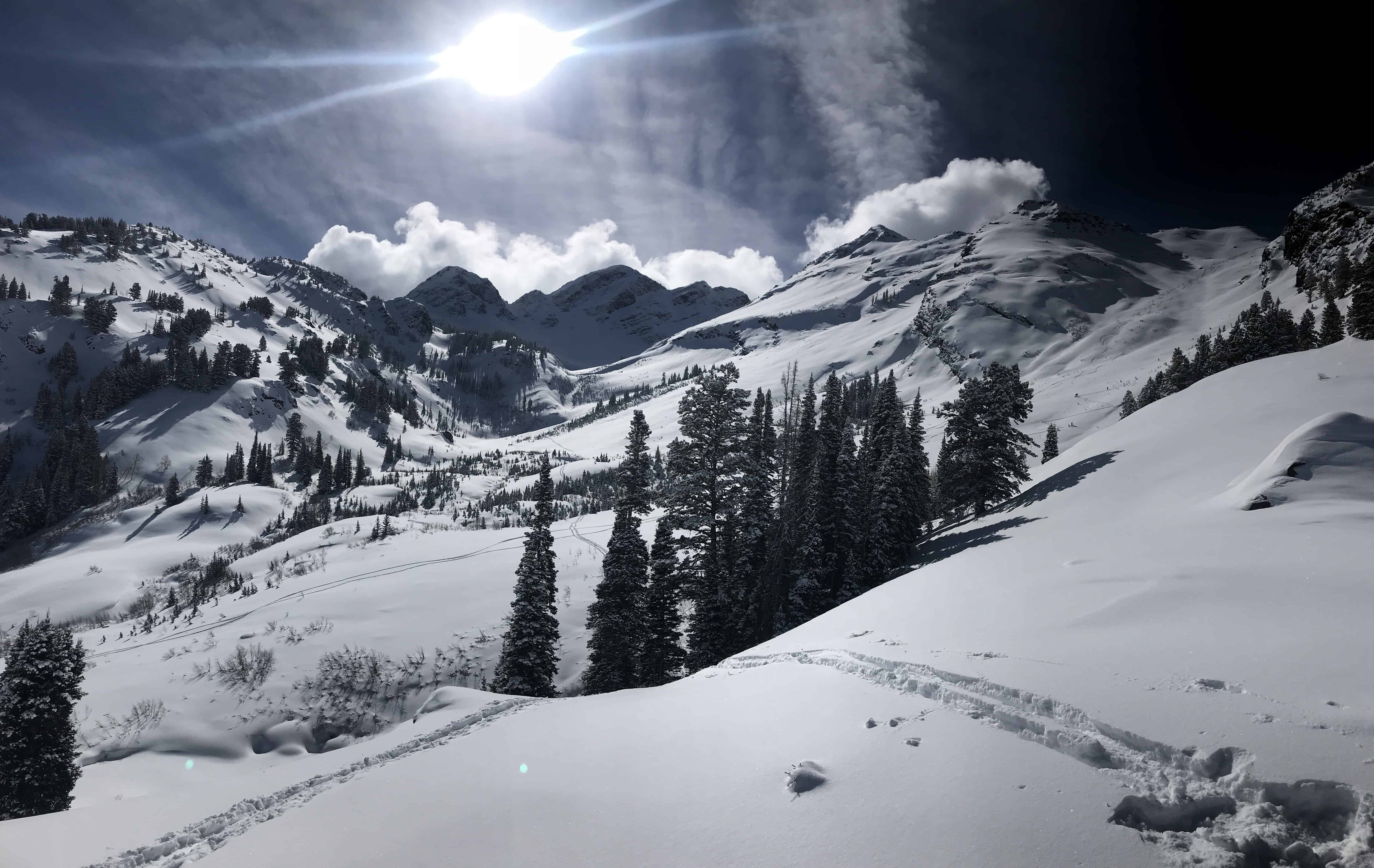
While the trail is short, it is consistently steep the entire way. Avalanche danger is fairly low until the meadow, but only experienced mountaineers should go beyond, as it is all avalanche country and unprepared hikers can risk serious injury.
Essential Winter Hiking Gear
If you’ve made it this far, you’ve probably noticed a common theme: gear is everything! Knowing what to use and when made all the difference for me and helped me fall in love with winter hiking. Let’s start with the gear first before diving into clothing, because both play a huge role in staying comfortable, safe, and enjoying your time on the trail.
Traction Devices
There are many types of traction devices on the market, so let’s simplify. First, skip the basic traction cleats (like YakTraks). They’re great for flat city walking but absolutely useless on icy hiking trails, so avoid them. Instead, look for Microspikes, which are made up of a dozen small steel spikes that dig into the ice and almost make you feel invincible, even on steep slopes!
Next up are snowshoes. I highly recommend a solid pair of MSR Lightning or Revo series, which feature a toothed outer edge and act as one continuous crampon, increasing traction ten-fold! This is a total game changer for breaking steeper trails in deep powder. Traditional snowshoes with a smooth tubular frame aren’t as great!
Finally, there are crampons and ice axes, but unless you’re tackling steep, technical climbs, you won’t need them.
✅ Kahtoola Microspikes – High quality, durable
Since 2017, these Kahtoola Microspikes have saved me from slipping on icy trails more times than I can count and thus live in my backpack all winter! This is also why I advise against the YakTraks cleats. Without the dozen small steel spikes, you can still slip on icy trails.
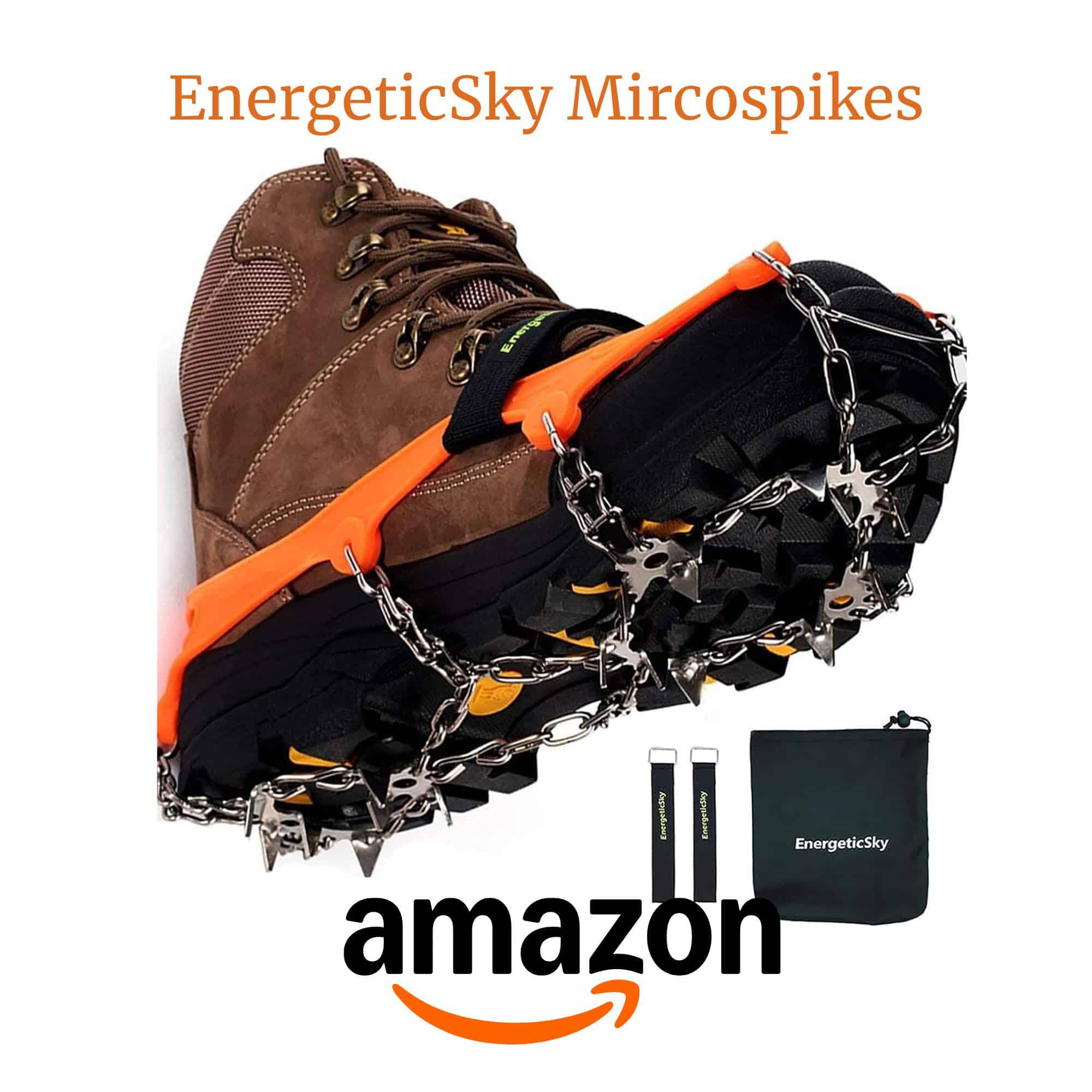
✅ EnergeticSky Microspikes – Budget-Friendly Option
If you’re more on a budget, these microspikes are a fantastic choice. I originally grabbed a pair for my partner in 2024, and they worked so well for her that I ended up buying a backup pair for myself!
✅ MSR Snowshoes
I started with a budget pair of snowshoes from Costco, but after upgrading to the MSR Lightning Ascents years later, I never looked back. The bindings are so much simpler to adjust, and the toothed frame grips much better on steep slopes without slipping (which was so frustrating with my first pair). They’re one of the best winter hiking investments I’ve made.
✅ Black Diamond Crampons and Ice Axe
For all the hikes I have listed, these two pieces of gear not necessary. However, I own a pair that I use for mountaineering that I absolutley love and they’re both made by Black Diamond, one of the best mountaineering companies in the U.S and they’re based right here in Salt Lake City, Utah
Clothing and other essentials
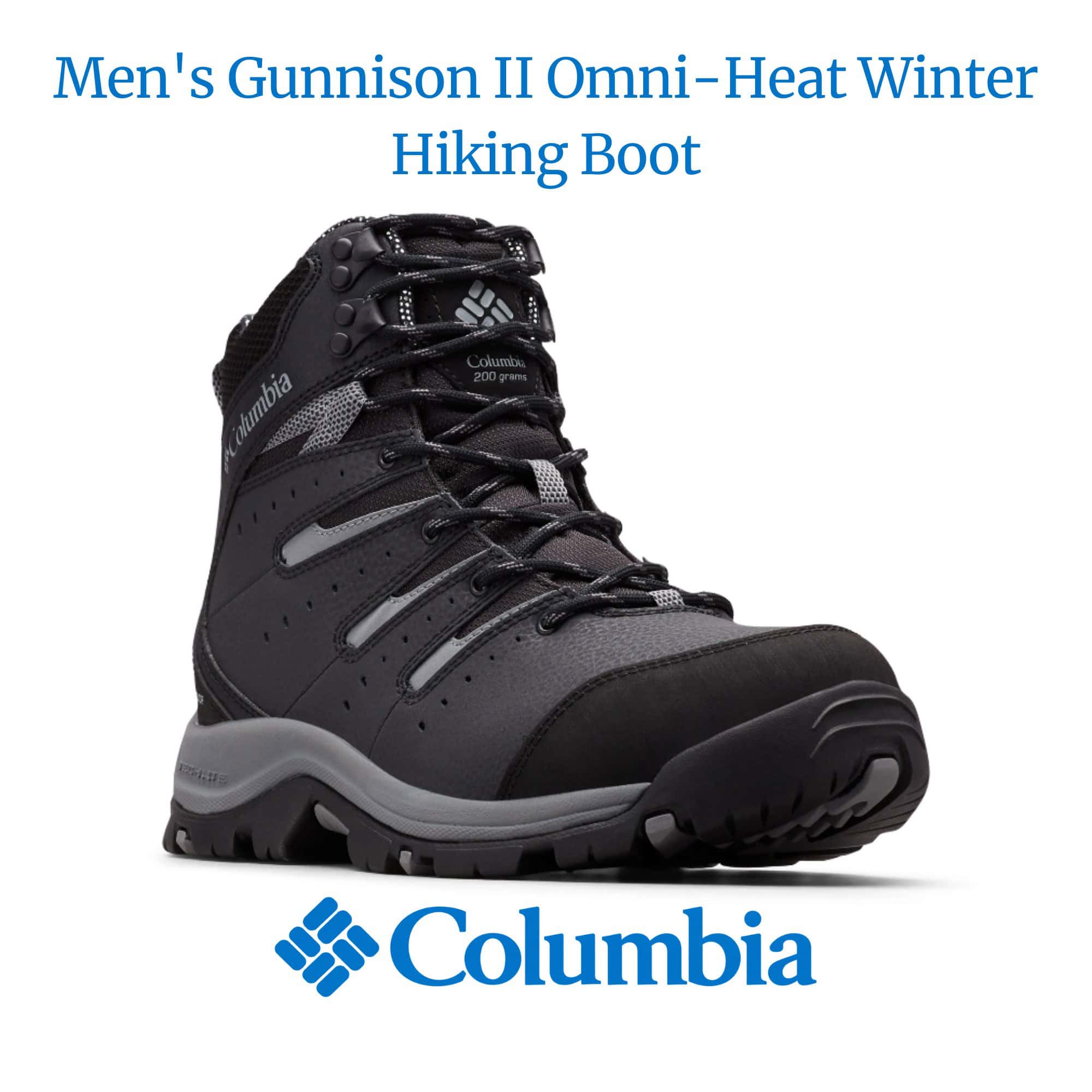
Columbia Men’s Gunnison II Omni-Heat Boot
These boots are built with Columbia’s Omni-Heat™ thermal-reflective lining, feature full insulation on the inside, and use waterproof-breathable membranes to keep your feet warm, dry, and comfortable in cold, slushy, or snowy conditions. I love these shoes, and I am often excited to dust them off every winter!
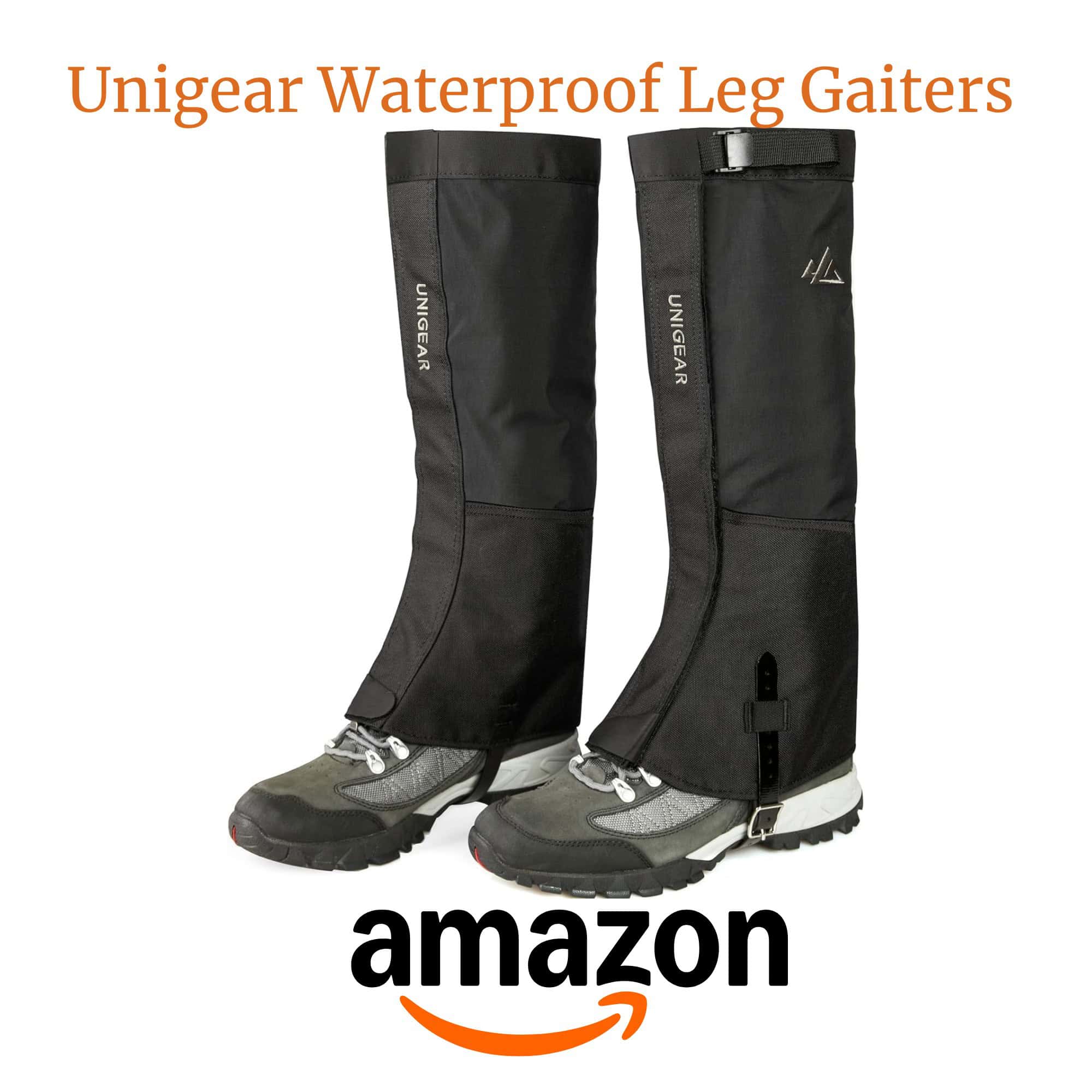
Unigear Waterproof Slip-on Gaiters
While waterproof shoes do an amazing job, sometimes the snow is so deep that even ankle-high shoes can’t keep you dry. That’s why I always pack these gaiters. They easily slip on over your hiking boots and act like a shield, keeping you dry and warm on those deep snowy hiking trails!
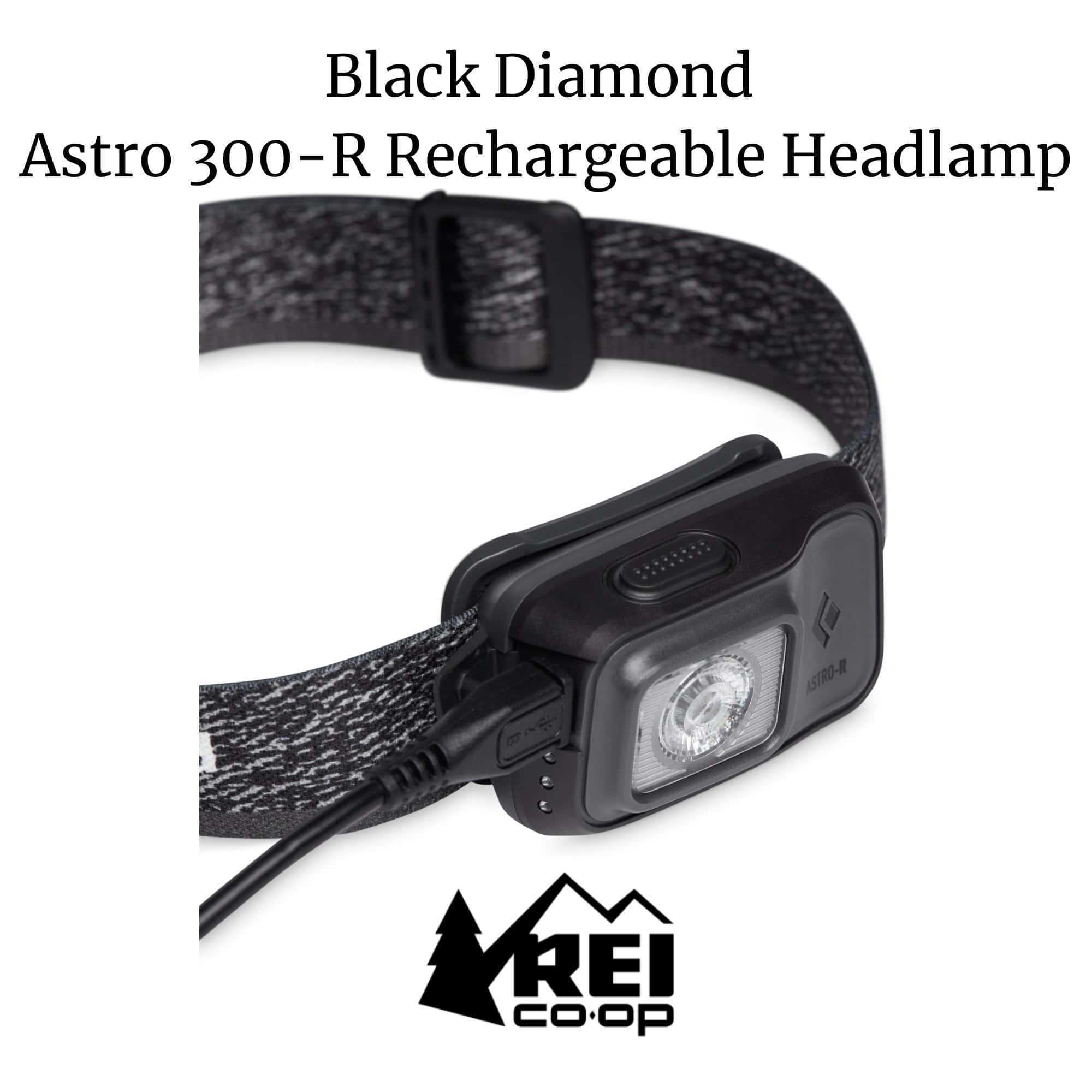
Black Diamond Astro 300-R Rechargeable Headlamp
I love Black Diamond for their mountaineering gear but surprisngly, they also make the best headlamp I have ever owned as well! It’s super bright, easy to use and comfortable while using rechargeable batteries you charge with a USB cable, making it super easy to charge on-the-go!
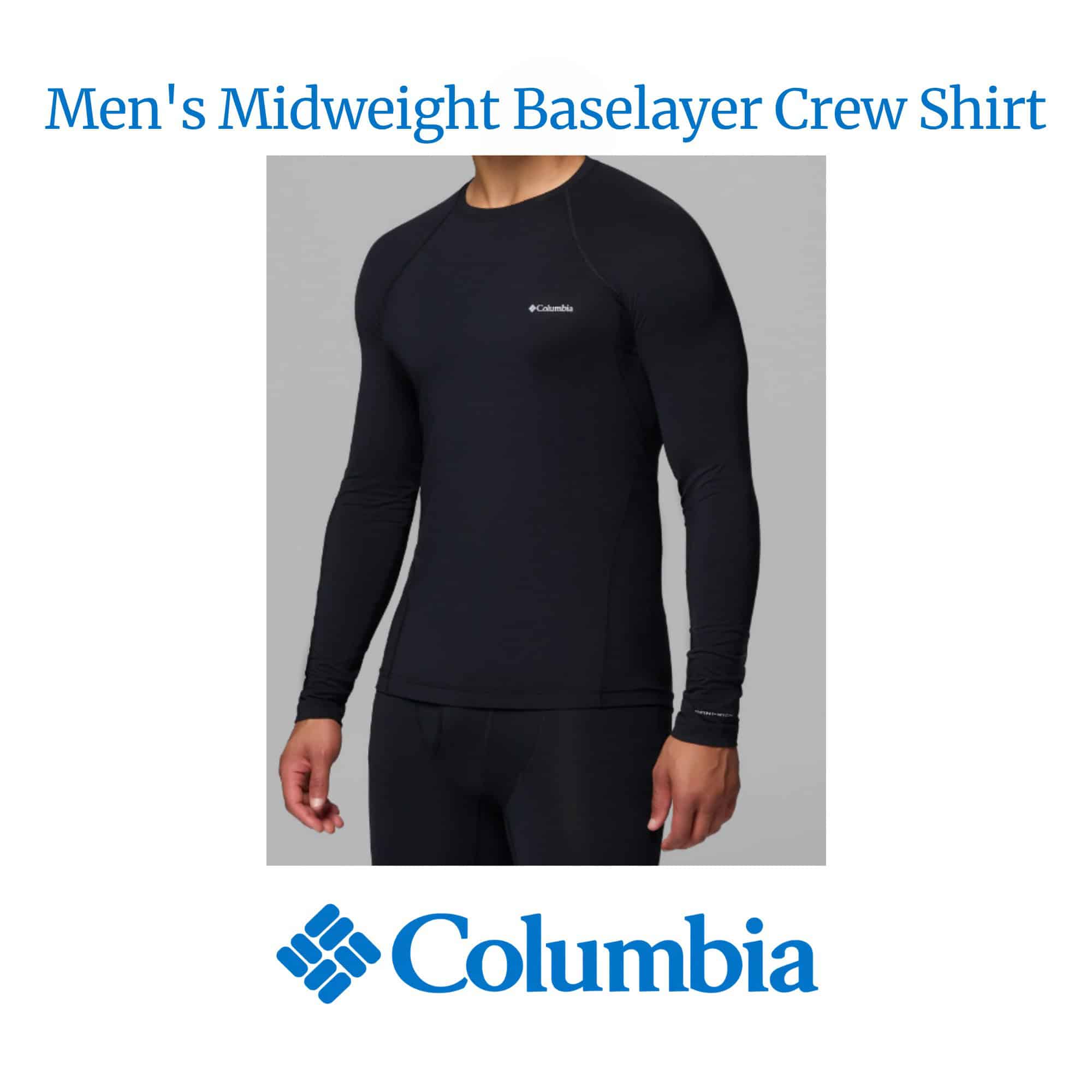
✅ Columbia Midweight Base Layer
Layering is the secret to surviving the cold, and this Columbia base layer is a total staple in my kit. It strikes the perfect balance: it keeps me toasty but wicks sweat away effectively during steep climbs, so I never end up freezing and clammy once I stop moving.
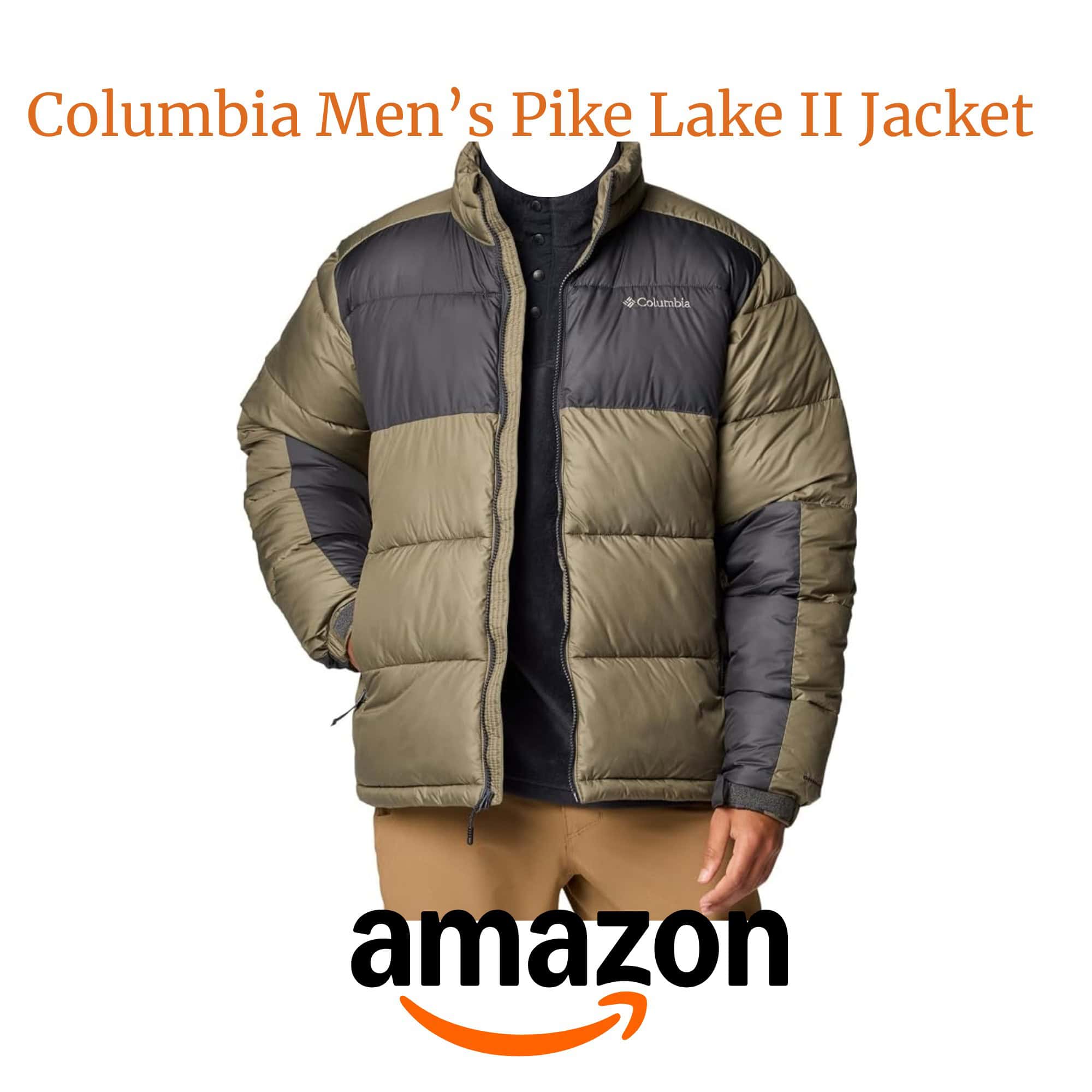
✅ Columbia Pike Lake II Jacket
I love layering this Columbia Pike Lake II Jacket on top of my baselayer and midlayer. It’s surprisingly lightweight and comfortable, and delivers that extra layer of warmth necessary to keep me warm on those freezing cold hiking days!
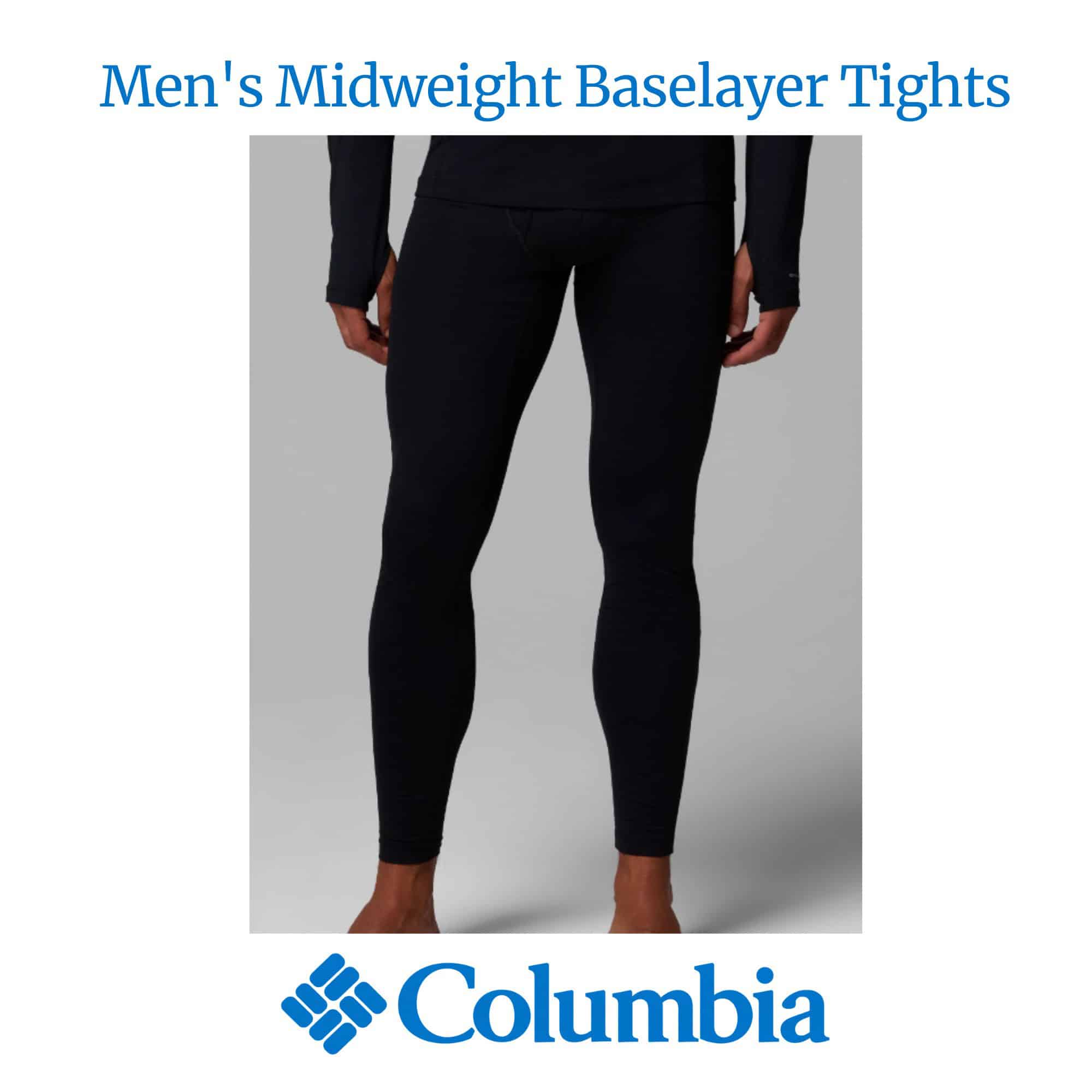
✅ Columbia Midweight Baselayer Tights
I layer these tights underneath my regular hiking pants. They insulate my body heat without feeling too bulky, so my stay warm without feeling too restricted!
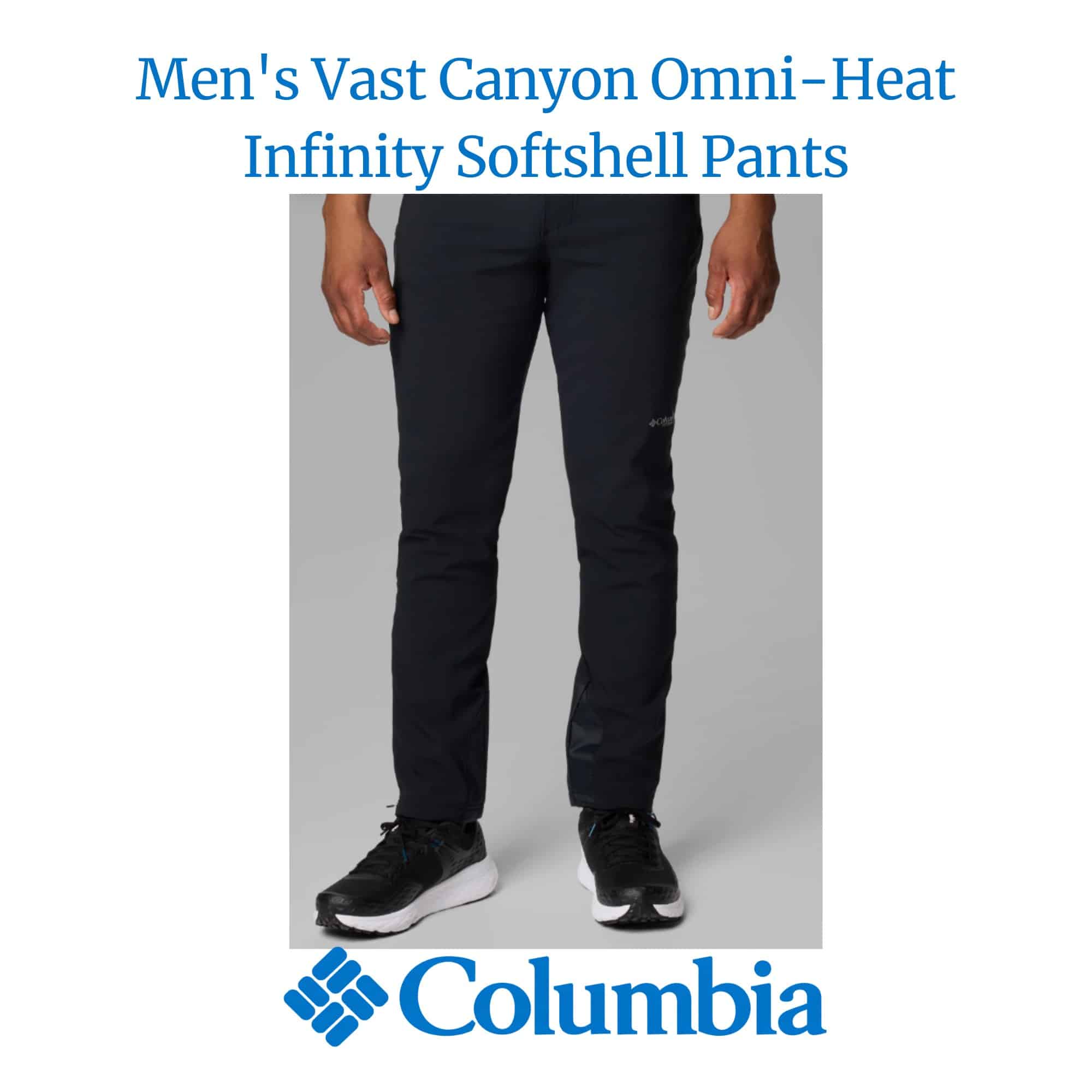
✅ Columbia Omni-Heat Infinity Softshell Pants
I’ve been incredibly lucky with Columbia’s winter gear in general, and these softshell pants are no exception. They offer serious warmth and are just incredibly comfortable, making them a reliable choice for the trail no matter how chilly it gets.
FAQ’s
We often get asked questions about winter hiking near Salt Lake City, so we’ve rounded up the top ones we get asked most often, and answered all of them here!
Can I Bring My Dog?
Little and Big Cottonwood Canyons are part of the Wasatch Front watershed, and dogs are not allowed on trails within these canyons. Millcreek Canyon allows dogs, but they may only be off-leash on odd-numbered days. Most of the foothills are dog-friendly, so you’ll find plenty of options just outside the Cottonwood Canyons.
Will I have issues finding parking?
While winter hiking is less popular than summer, trailheads can fill up quickly, especially on weekends. Trailheads in the Cottonwood Canyons are especially popular with backcountry skiers, while Millcreek Canyon parking lots are smaller and fill up fast. Arriving early is always your best bet.
Is Salt Lake City good to visit in December?
Beyond the hiking scene, Salt Lake City offers plenty during the winter months! While temperature inversions can frequently blanket the valley in a layer of haze, clear days provide postcard-worthy, winter wonderland views. If you are looking for more things to do, check my guide here.
How cold is too cold for winter hiking?
This largely comes down to personal preference and proper gear. I find extremely cold temperatures to be less than ideal, but they often create better trail conditions than warmer days, when snow turns slushy and muddy. Salt Lake City typically experiences its coldest temperatures in late December and January, but the rest of the season can be surprisingly mild and pleasant for hiking.
Final Thoughts
I hope this list of the best winter hikes near Salt Lake City showed you that winter hiking is very much worth it! While it might sound intimdating at first, once you understand when to use the correct gear, the snow-blanketed landscapes may become some of your favorites!
On my own journey, I went from being freezing and miserable to actually looking forward to crisp mountain air, and it all it took was a few smart adjustment. Whether you’re chasing frozen waterfalls or quiet, snow-blanketed ridges, lace up, stay prepared, and let the Wasatch Mountains show off their winter magic. Happy trails!